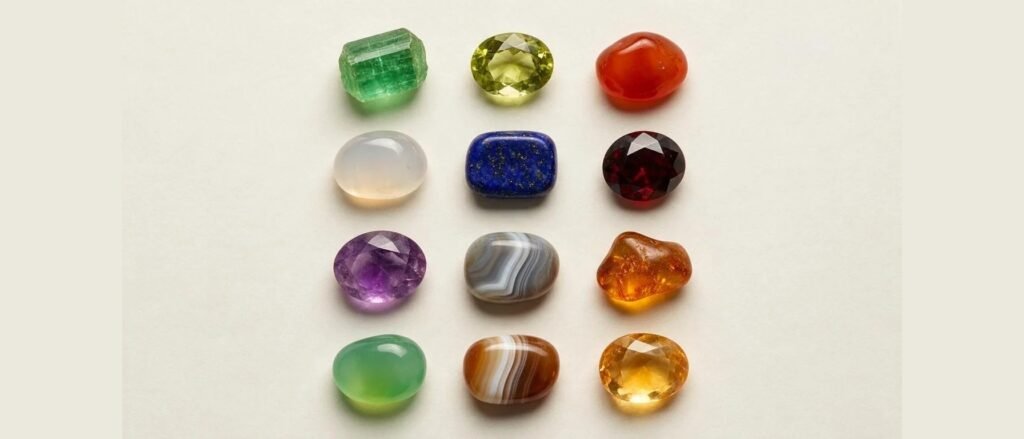
A FEDIYAR collection
A short passage in the Book of Exodus describes a ceremonial breastplate set with twelve stones, arranged in four rows of three, each engraved with a name. The description is oddly practical — it reads less like scripture than like an instruction to a workshop. It gives dimensions, materials, an order of assembly.
And then it gives twelve names that nobody has been able to translate with confidence for two thousand years.
That gap is the subject of this collection. Not the ritual, not the theology, but the stones themselves: what they were made of, where they came from, who cut them and traded them, and how twelve ordinary lapidary terms turned into one of the longest-running puzzles in the history of materials.
The passage is a useful place to begin because it catches the ancient gem trade in mid-sentence. Every stone in that list had to be sourced, transported, cut and engraved by someone. Behind each name sits a mine, a route, a workshop and a market. Some of those routes ran for thousands of kilometres. Some of those workshops are still operating.
The twelve
| Hebrew | Read today as | The essay | |
|---|---|---|---|
| 1 | אֹדֶם ’odem | Carnelian | The stone that accepts a name |
| 2 | פִּטְדָה piṭdah | Peridot | The stone named after a search |
| 3 | בָּרֶקֶת bāreqet | A green stone | A word that means lightning |
| 4 | נֹפֶךְ nofekh | Garnet — or turquoise | The stone two traditions cannot agree on |
| 5 | סַפִּיר sappir | Lapis lazuli | The blue that was never a sapphire |
| 6 | יָהֲלֹם yahalom | Disputed | The stone named for a blow |
| 7 | לֶשֶׁם leshem | Unknown | The stone nobody can name |
| 8 | שְׁבוֹ shevo | Agate | No two alike |
| 9 | אַחְלָמָה ’aḥlamah | Amethyst | The colour that was reserved |
| 10 | תַּרְשִׁישׁ taršiš | A golden stone | Named for a port at the edge of the map |
| 11 | שֹׁהַם šoham | Disputed | The stone chosen to be written on |
| 12 | יָשְׁפֵה yašfeh | Jasper — of a kind | One word, two different stones |
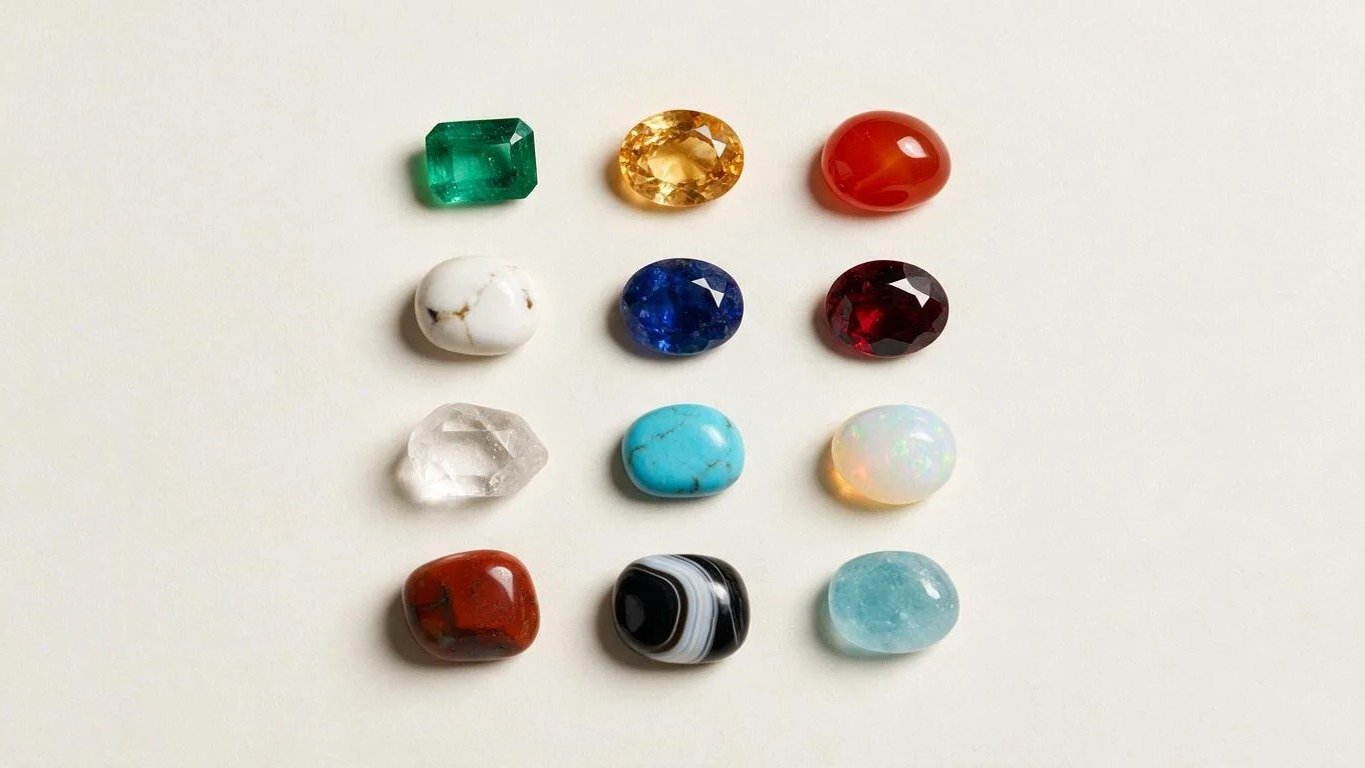
Why the names are uncertain
Ancient languages did not classify stones the way modern mineralogy does. A Greek or Akkadian gem name usually described what a stone looked like — its colour, its lustre, the way it caught light — rather than what it was made of. Several different minerals could share one name. One mineral could carry several.
The evidence for what these twelve words meant comes mainly from translation, and the translations disagree.
The Greek Septuagint, made in Alexandria in the third or second century BCE, gives one set of equivalents. Jerome’s Latin Vulgate, some six centuries later, gives another that does not entirely match. Josephus, writing in the first century CE and presumably able to consult people who had seen such objects, produces the list twice — and his two versions differ from each other as well as from the Septuagint.
Modern scholarship adds a further constraint, and a useful one: whatever these stones were, they had to actually exist in the region at the time, and they had to be engravable. The text is explicit that each stone was cut with a name, as a seal is cut. That single requirement rules out several of the identifications that later tradition made confidently — most famously diamond, which could not be worked with the tools available, and corundum sapphire, which was not a carved gem of the ancient Near East.
So the honest position is a graded one. A few identifications are close to secure. Several are plausible but contested. At least one is genuinely unknown, and has been unknown since antiquity.
How this collection is written
Three things get separated throughout, and we say which is which:
What the ancient text says. Exodus lists twelve stones and twelve names. It does not say which stone carried which name — that detail is simply absent. Every stone-to-name pairing you may have encountered comes from later commentary, and the commentators do not agree among themselves. Where we mention such a tradition, we mark it as one.
What later traditions made of it. Jewish, Christian and Islamic commentary each built on this passage over centuries, and several of these stones have parallel lives in Persian, Mesopotamian and Egyptian material culture that owe nothing to the biblical text at all. Those lives are often the more interesting half of the story.
What mineralogy proposes now. Where an identification is debated, we set out the debate rather than picking a winner and moving on.
The result is not a work of scholarship — it is a collection of essays for people who care about objects. But it is written so that nothing in it would embarrass you if a specialist read it.
Begin with carnelian, the one stone in the list whose name still means exactly what it says.


