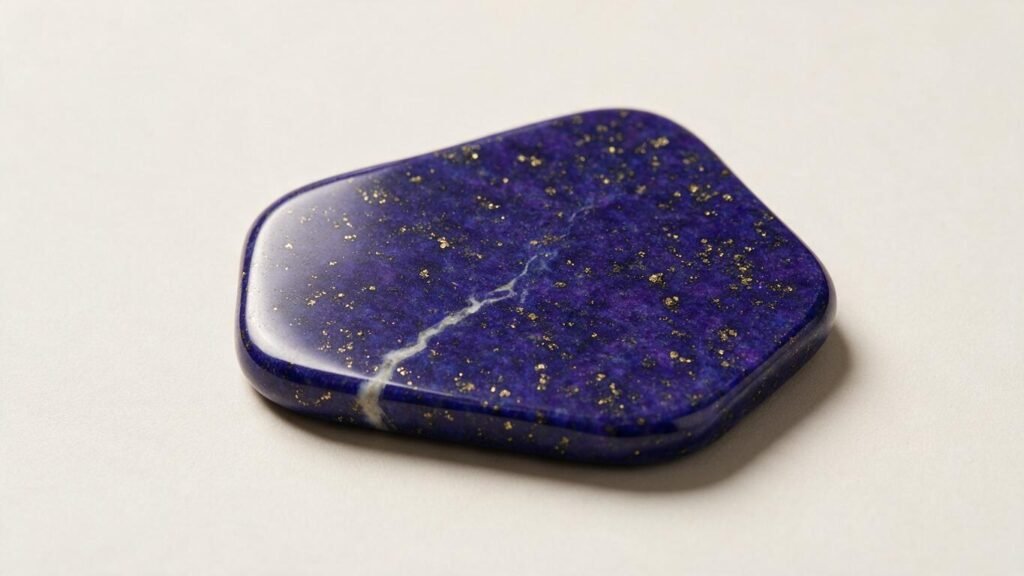
Lapis lazuli — Sappir, the fifth of the twelve ancient stones
Hold a good piece of lapis under a lamp and the metallic specks scattered through it catch the light one at a time, the way a city looks from an aircraft at night.
Pliny, describing the stone he knew as sappheiros, reached for almost the same observation. A blue stone, he says, flecked with gold.
He was not describing a sapphire.
Sapphire has no gold in it. What Pliny had in front of him was lapis lazuli, whose blue lazurite is threaded with brassy pyrite — and that single detail, recorded in passing two thousand years ago, is one of the more satisfying corrections in the history of gemstones.
1. A Word That Drifted
The Hebrew is סַפִּיר — Sappir, and the family resemblance to sapphire is not an illusion. The Greek sappheiros, the Latin sapphirus and the English word all descend from it.
The word survived intact for three thousand years. Its meaning did not.
Two arguments make lapis the far stronger reading, and neither depends on translation.
The first is Pliny’s gold flecks. Corundum sapphire is a single mineral, chemically clean. Lapis lazuli is not a mineral at all — it is a rock, an aggregate in which blue lazurite is mixed with white calcite and grains of pyrite. A stone described as blue with gold in it is lapis. Sapphire cannot produce that description.
The second argument is the one that runs through this whole collection. Exodus is explicit that each of the twelve stones was engraved with a name, as a seal is engraved.
Lapis takes engraving readily. Mesopotamian workshops cut lapis cylinder seals for millennia and the objects survive in quantity. Corundum sapphire, at 9 on the Mohs scale, was not a carved gem of the ancient Near East; the abrasives and drills of the period could not touch it.
Whatever Sappir was, a lapidary could work it.
Elsewhere in the Hebrew Bible the word appears where the text is reaching for something above the ordinary world — a pavement beneath a divine appearance, a throne. The choice makes sense. This was the deepest, most saturated blue anyone in that world had ever seen.
In one line of interpretive tradition the stone is associated with Issachar. The text itself makes no such assignment; the pairings come from later commentary, and the commentators do not agree.
2. The Material
Lapis is a rock with a mineral’s reputation, and the distinction matters commercially.
Its blue comes from lazurite, a sulphur-bearing member of the sodalite group. The sulphur is why the colour is what it is, and no other common mineral produces that saturation.
Grade is decided by what surrounds the lazurite.
Calcite shows as white veining or a chalky haze; too much of it and the stone reads grey. Pyrite is the ambiguous one — a fine dusting is prized and proves origin, while heavy pyrite makes the stone look green and dull.
The most sought material is described in the trade as an even, slightly violet-leaning blue with a light scatter of gold, and no white at all.
At 5 to 5.5 on the Mohs scale it is soft. That is why it was carved into bowls, inlays, seals and beads rather than faceted, and why antique lapis surfaces are gently worn.
It is also porous. It takes wax and oil, it dislikes solvents, and a badly stored piece will fade.
And that softness had one further consequence, which changed the history of European painting: lapis can be ground.
3. One Valley
Here is the fact that makes this stone unlike anything else in the collection.
For most of recorded history, effectively all the lapis lazuli in the world came from a single group of mines in the Sar-e-Sang valley of Badakhshan, in the mountains of north-eastern Afghanistan.
Not a region. A valley.
The workings there have been exploited for around six thousand years, at altitude, in conditions that have never been easy. They are worked still.
Everything else follows from that. Lapis found in the royal graves at Ur travelled some two thousand kilometres. Lapis inlaid into Egyptian funerary goods travelled further. The stone appears across the entire ancient Near East, in societies with no direct contact with one another, and all of it came out of the same mountainside.
The Egyptians wanted it badly enough that when supply failed they manufactured a substitute — Egyptian blue, a synthetic calcium copper silicate and the earliest artificial pigment known, made specifically to stand in for a stone they could not reliably obtain.
Imitation on that scale is the most reliable measure of desire we have.
4. Where Traditions Meet
The name carries the route.
The Persian lāzhward named both the stone and the place it came from. It produced the Arabic lāzaward, the medieval Latin lazulum, and eventually both “lazuli” and — with the initial letter lost along the way — the French azur and the English azure.
The everyday word for the colour of the sky is the fossil of a trade route.
The same material travelled in two directions once it was ground. Persian and Mughal manuscript illumination used ultramarine against burnished gold with an assurance European painting rarely matched; the pairing of that blue and that gold on the page is one of the great achievements of Islamic book arts.
In Europe the same pigment went into altarpieces. Two traditions, one valley, and neither of them anywhere near it.
5. The Most Expensive Colour Ever Used
Ground fine and purified through a laborious process involving wax and lye, lazurite yields ultramarine — a pigment whose Italian name, oltremare, means simply “from beyond the sea.”
By weight it cost more than gold, and Renaissance contracts treated it accordingly. Patrons specified how much ultramarine a painter was obliged to use, and of what quality, in the same clauses that fixed his fee.
Because the pigment was reserved for whatever mattered most in a composition, it acquired a meaning it never had as a stone. In European painting it became the colour of the principal figure, and above all of the Virgin’s mantle.
The blue signalled expense before it signalled anything else, and everyone looking at the picture understood that.
Then, in the 1820s, chemists succeeded in synthesising ultramarine. The colour that had been rationed by contract became available to anyone with a few coins.
It is difficult to think of another luxury that collapsed so completely, so fast. And the synthetic version is what Yves Klein was working with, a century later, when he set about making a blue that would swallow the eye.
6. Lapis Now
Contemporary use divides cleanly.
Watchmaking treats lapis as a dial material, cut in slices thin enough to glow at the edge. Because no two slices carry the same veining, a stone-dial watch is effectively a unique piece, and the collectors’ market has come to price it that way.
Jewellery uses it as a cabochon or a carved element, where it does something few coloured stones can: it reads as a block of pure colour at any distance, in any light, without needing to be looked into. That is why it has always suited bold, graphic design.
Interiors have gone furthest — table tops, inlay, cabinet panels, and a handful of extraordinary commissions where whole surfaces are faced with it. Against pale marble or dark bronze it holds its own completely.
7. What Makes It Distinctive
Almost every material in the luxury world can tell you roughly where it came from. Lapis can tell you exactly.
Six thousand years of a global material with essentially one source is not a story any other gemstone can tell. It means that a bead from a Mesopotamian grave, an inlay from an Egyptian tomb, the blue of a Persian manuscript and a modern watch dial are, in a strict physical sense, the same rock from the same mountain.
Very few things connect that many centuries through a single point on a map.
There is a lesson in it about how value works. Lapis is not hard, not rare in absolute terms, not brilliant, not transparent. It fails most of the criteria by which gemstones are conventionally ranked.
What it has is a colour nobody could reproduce and an origin nobody could substitute. That was enough to make it one of the most travelled materials of the ancient world.
8. A FEDIYAR Note
Provenance is the quietest of the luxury arguments and, in the end, the most durable one.
Craft can be matched. Rarity can be undercut by a new discovery next year. Origin cannot be moved.
What lapis lazuli demonstrates, more clearly than any other stone here, is that some things are valuable because of where they are from and cannot be otherwise. Six thousand years of caravans crossing mountain ranges to reach one valley is not a marketing claim. It is a fact about geology that people organised their trade around.
Worth remembering, in a market increasingly built on things that could have come from anywhere.
FEDIYAR
Craft can be matched. Scarcity can be undercut.
Origin is the one thing that cannot be moved.
Previously: Nofekh — the stone two traditions cannot agree on.
Related: Tarshish — named for a port at the edge of the map · Shoham — the stone chosen to be written on.
A note on method: throughout this collection we distinguish three things — what the ancient text actually says, what later traditions made of it, and what modern mineralogy proposes. Where an identification is debated, we say so.


