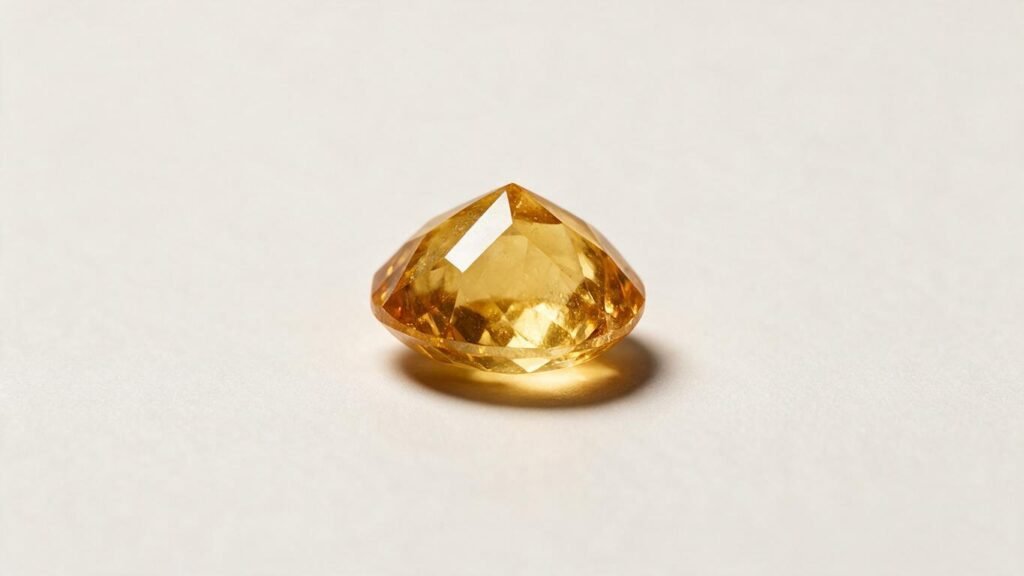
Tarshish — the tenth of the twelve ancient stones
Eleven of these stones are named for how they look, what they do, or nothing we can recover.
One is named for a destination.
תַּרְשִׁישׁ — Tarshish is a place before it is a gem: a port that appears throughout the Hebrew Bible as the far end of the known world, the harbour you sailed to when you were going as far as ships went.
And nobody has established where it was.
1. A Stone Called Somewhere Else
The Septuagint renders Tarshish as chrysolithos — gold-stone. The Vulgate follows with chrysolithus.
That tells us the colour and almost nothing else, because chrysolithos was another of those ancient catch-alls, applied to any transparent stone with a golden cast. Yellow jasper, topaz, citrine, yellow beryl and peridot have all been proposed, and there is no way to choose between them from the word alone.
What the biblical text gives us instead is a set of visual impressions, and they are unusually consistent.
The Song of Songs describes hands like rods of gold set with tarshish. Daniel describes a body with the appearance of tarshish. Ezekiel, twice, describes wheels that look like tarshish — and the wheels are moving.
Every one of these is a flash of gold in motion, seen at a distance. Not a colour so much as a behaviour of light.
The colour is secure. The mineral is not. In one line of interpretive tradition the stone is assigned to Asher; as throughout this collection, the text makes no such assignment and the commentators differ.
2. Where Was Tarshish?
The candidates have been argued over for centuries, and each has something going for it.
Tartessos, in southern Spain beyond the Strait of Gibraltar, is the oldest and most popular identification. It was a real trading culture, fabulously rich in silver, and the Phoenicians worked it hard. It sits at the outer limit of Mediterranean navigation, which fits the way the biblical text uses the name.
Tarsus, in Cilicia, has phonetic similarity and a long history as a port.
Sardinia has been proposed on the basis of an inscription.
The phrase “ships of Tarshish” complicates all of it, because in several passages it plainly means a type of vessel rather than a destination — a deep-water ship, built for long voyages, regardless of where it was going. Much as an East Indiaman was a class of ship long after it stopped meaning a particular route.
So the name may designate a place, or a kind of voyage, or both. It has resisted resolution for a very long time, and this essay is not going to settle it.
3. Stones Named for Harbours
Here is the pattern that makes Tarshish worth an essay of its own.
Materials are very often named for where they were bought, not where they were made.
Turquoise is French for Turkish, and no turquoise of consequence has ever come from Turkey — the stone arrived in Europe through Turkish traders. Damask is named for Damascus, muslin for Mosul, denim for Nîmes, jeans for Genoa, and india ink came from China.
The name records a transaction, not an origin.
For most of history this was not sloppiness. It was the only information anyone reliably had. A merchant in Tyre knew which harbour a cargo came off. He did not know, and had no way to find out, which valley three months inland had produced it.
Tarshish is that principle applied to a gem. Somewhere upriver of that harbour was a deposit with a name of its own, known to the people who dug it and to nobody else.
The stone kept the name of the last place it changed hands.
4. Where Traditions Meet
The Phoenician network that ran these routes is the connective tissue behind half of this collection.
The same ships that carried a golden stone west carried lapis and carnelian east, Egyptian faience north, and Baltic amber south. Tyre and Sidon were clearing houses, and the biblical texts that list their trade — Ezekiel’s catalogue is the richest — read as a manifest of the ancient luxury economy.
What is striking, reading that catalogue now, is how modern the structure is. Specialised sources, long supply lines, intermediaries who never saw the origin, and goods whose names had already detached from the places that made them.
The gap between a thing’s origin and the story told about it is not a modern problem. It is the oldest condition of the trade.
5. What Gold-Coloured Light Has Been Made to Say
The passages that use tarshish are not describing an object. They are describing an effect — something bright and moving, seen from far off, that the writer reaches for a gemstone to convey.
Across cultures, golden light has tended to carry two ideas at once: value, obviously, and distance. The sun, the horizon, the far shore. Something desirable and not yet arrived.
A stone that held that colour was doing double duty. It was the material of wealth, and it was a small portable piece of the elsewhere that the wealth had come from.
For a society whose luxury goods all arrived by sea, that was not a metaphor. It was an accurate description of the supply chain.
6. The Modern Return of Origin
For most of history, as we have said, nobody could establish where a stone came from. The harbour was the whole story.
That changed recently, and completely.
Gemmological laboratories can now assign origin to many coloured stones by their trace-element chemistry and internal inclusions — the microscopic signature of the specific geology that formed them. A ruby can be attributed to a particular region. Sapphires are routinely separated by source.
The commercial consequence is large. Two stones identical to the eye, of the same weight, colour and clarity, can differ in price by a multiple, because a laboratory has assigned one of them to a more prestigious origin.
Which means the luxury market has quietly reversed four thousand years of practice. The harbour used to be the only fact available; now the harbour is irrelevant and the valley is everything.
It is worth being clear-eyed about what that premium actually buys. Part of it is genuine quality correlated with geology. Part of it is narrative — the same instinct that made Tarshish a name worth putting on a stone.
7. What Makes It Distinctive
Tarshish is the only one of the twelve whose name points away from the object entirely.
Odem names a colour. Bareqet names a flash. Yahalom names a blow. This one names the other end of a journey — a place the wearer had probably never seen and possibly could not have found.
There is something exact about that as a description of luxury, then and now. A significant part of what a rare object carries is the distance between where it was made and where it is being worn, and the wearer’s relationship to that distance is almost always imaginative rather than direct.
The stone is the near end of a line. Most of the line is invisible.
8. A FEDIYAR Note
Our own work sits on this line, and it is worth saying so plainly.
A property on a coast, a vessel, an object with a history — what makes each of them exceptional is rarely a single measurable quality. It is the accumulated distance in it: where the material came from, whose hands shaped it, what had to happen for it to end up in front of you.
That distance cannot be manufactured and it cannot be shortened. It can only be documented, honestly, by people who took the trouble to find out.
Tarshish is the reminder of what happens otherwise. A stone arrives, the harbour gets the credit, and four thousand years later nobody can say where it was actually from.
FEDIYAR
The name on the label is usually the last place it stopped.
Everything interesting happened before that.
Previously: Amethyst — the colour that was reserved.
Related: Lapis lazuli — the blue that was never a sapphire · Peridot — the stone named after a search.
A note on method: throughout this collection we distinguish three things — what the ancient text actually says, what later traditions made of it, and what modern mineralogy proposes. Where an identification is debated, we say so.


