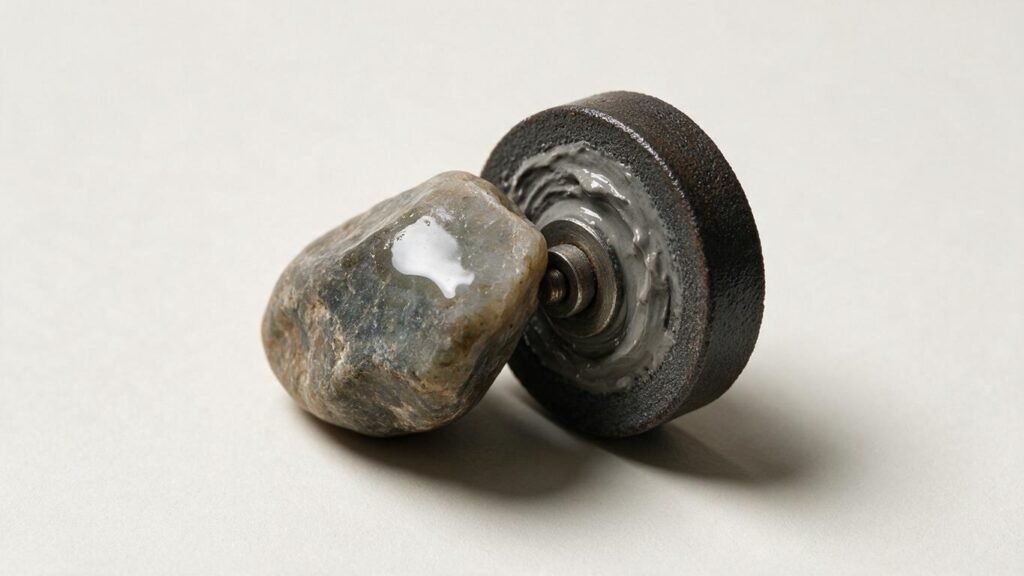
Yahalom — the sixth of the twelve ancient stones
Ten of these twelve names describe how a stone looks. One describes where it came from.
This one appears to describe what it does to your tools.
יָהֲלֹם — Yahalom is usually connected to the root h-l-m, which carries the sense of striking, hammering, hitting hard. Whatever the stone was, its name is about resistance — about a material that gives a mason’s arm something to argue with.
That puts this essay somewhere unusual for a collection about gems. It is not really about a stone at all. It is about hardness, and about the tools that were available to work it.
1. Why It Cannot Be a Diamond
Open most English Bibles at Exodus 28 and you will find the word diamond.
It is a medieval reading, it is very unlikely to be right, and the reason is worth setting out, because it is the clearest example in this collection of a later assumption being read back into an older text.
Exodus is specific that every one of the twelve stones was engraved with a name, in the manner of a seal.
Diamond cannot be engraved by anything except diamond. Nothing else in the mineral world is hard enough to mark it. The technique of cutting diamond with its own powder does not appear in Europe until the late Middle Ages — and even then it arrives as a difficult novelty, not a workshop routine.
A pre-Roman lapidary confronted with a rough diamond had, in practical terms, a very hard pebble. He could not shape it, polish it or write on it.
There is also the matter of supply. Diamond came from India and reached the Mediterranean world in small quantities, valued precisely for being unworkable — the stone that defeated tools.
The Septuagint, for what it is worth, gives iaspis here, which points toward something in the jasper or chalcedony family. Modern scholarship has proposed jasper, onyx, moonstone, rock crystal and several others. None commands agreement.
In one line of interpretive tradition the stone is associated with Zebulun. The biblical text makes no such assignment, and the commentators differ.
2. What Hardness Actually Means
We use one word for two different properties, and confusing them has cost a great many stones their lives.
Hardness is resistance to scratching. Toughness is resistance to breaking. They are not the same and they do not travel together.
Diamond is the hardest natural material and it has perfect cleavage — planes along which it will part cleanly if struck correctly. A diamond is supremely difficult to scratch and entirely possible to split with a well-placed blow. The whole craft of diamond cutting is built on exploiting that fact.
Jade is the reverse. It is only moderately hard, but its interlocking fibrous structure makes it extraordinarily difficult to break. Cultures that worked jade made axe heads from it.
The scale everyone quotes was put together in 1812 by the German mineralogist Friedrich Mohs, and it is worth knowing what it is not. It is not a measurement. It is an ordering — each mineral scratches the one below it, and that is all the number tells you.
The gaps are wildly uneven. Corundum sits at 9 and diamond at 10, and in absolute terms diamond is several times harder than corundum. The last step on the ladder is longer than all the others put together.
3. The Tool Was Never the Hard Part
Here is the thing most people get wrong about ancient gem cutting.
You do not cut a hard stone with a harder tool. You cut it with a softer tool that carries a harder powder.
A bronze or copper wheel, on its own, will do nothing to quartz. Charge that same wheel with a paste of abrasive grit and water, and it will cut — because the metal is soft enough to hold the particles while they do the work. The wheel is a carrier.
Everything turns on the powder. Quartz sand cuts soft stones. For anything harder, ancient workshops used emery — a naturally occurring rock rich in corundum, quarried on Naxos and other Aegean islands, and traded across the Mediterranean for exactly this purpose. The English word comes, by a long road, from that Greek source.
The machinery was simple and it hardly changed for three thousand years: a bow drill for holes, a tubular drill for hollowing, a rotating wheel or disc for facets and lines, and an enormous amount of time.
Which means the question “could this stone have been engraved?” has a precise technical answer for any given period. It depends entirely on what abrasive was in the workshop.
4. Where Traditions Meet
Hardness became a moral vocabulary almost everywhere, and the metaphors are strikingly consistent.
In many traditions the hard stone stands for what does not yield — constancy, an oath that holds, a word that cannot be taken back. Texts across the ancient Near East use the imagery of a scribe’s hard stylus and an unyielding surface to describe things written permanently.
There is a second, quieter theme, and it belongs particularly to craftsmen: the recognition that hardness is not strength. The hardest material in the workshop is also the one that shatters if you strike it wrongly.
Anyone who has actually worked stone knows this. It is the difference between a proverb and an occupation.
5. What Resistance Has Been Made to Say
Across cultures, the symbolic reading of hardness splits into two opposed lines, and both are still in circulation.
One treats it as a virtue: endurance, fidelity, the refusal to be marked by circumstance.
The other treats it as a warning: rigidity, coldness, the inability to be moved. Hard-hearted is not a compliment in any language we know of.
Yahalom sits at the crossing point of the two, and the ambiguity is probably deliberate. A stone chosen to carry a name for a very long time is being asked to be unmoved. That is an asset in an object and a liability in a person.
6. Hardness as a Modern Luxury Argument
Look closely at how objects are sold now and you will find this same idea doing commercial work.
Watchmaking made scratch resistance a selling point, and then a technical arms race: sapphire crystal over the dial, ceramic bezels, hardened alloys, coatings with names borrowed from materials science. The claim being made is not that the watch will keep time. It is that the watch will not look used.
That is Yahalom’s logic, four thousand years on. A material valued because the world cannot leave a mark on it.
There is a counter-current worth naming, because the best objects tend to sit on the other side of it. Patina — the darkening of silver, the softening of leather, the wear on a signet ring’s edges — is the visible record of a thing having been used by someone. Hardness prevents exactly that.
The most interesting pieces usually decide which of the two they want, rather than pretending to offer both.
7. What Makes It Distinctive
Yahalom is the only stone here that we may never identify.
But it tells us something none of the others do, because it points away from itself and toward the workshop.
Every stone in this collection had to be found, transported, cut and engraved by someone who possessed specific tools and specific abrasives. Those constraints are as much part of the object’s history as the mine it came from — and unlike symbolism, they can be tested. A stone either could or could not be worked with the technology of a given century.
It is the least romantic question you can ask of an ancient gem, and the one most likely to get a straight answer.
8. A FEDIYAR Note
There is a version of luxury built entirely on resisting the world: harder surfaces, tougher coatings, guarantees against the ordinary evidence of use.
It is a real form of quality, and there is nothing wrong with wanting it.
But the objects that tend to be handed down are rarely the ones that stayed pristine. They are the ones that took the marks and remained themselves — the ring worn thin at one edge, the case whose corners have gone soft, the handle that has learned a particular hand.
Hardness is one answer to time. It is not the only one, and it is not always the better one.
FEDIYAR
Some objects survive by refusing the world.
Others survive by letting it show.
Previously: Lapis lazuli — the blue that was never a sapphire.
Related: Shoham — the stone chosen to be written on · Leshem — the stone nobody can name.
A note on method: throughout this collection we distinguish three things — what the ancient text actually says, what later traditions made of it, and what modern mineralogy proposes. Where an identification is debated, we say so.


