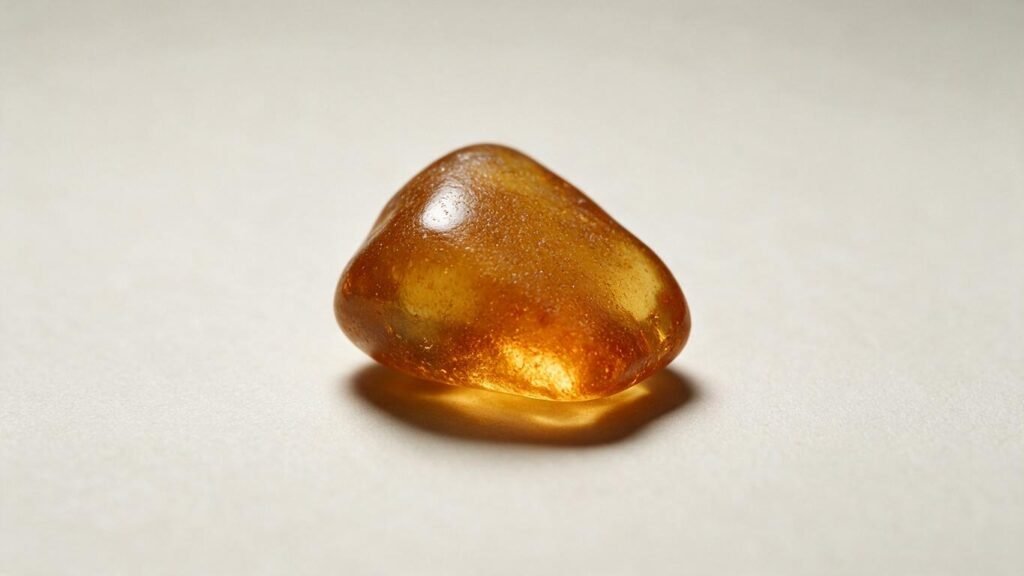
Leshem — the seventh of the twelve ancient stones
Every collection of this kind reaches a point where the honest answer is that we do not know.
This is that point, and it arrives earlier than expected — not at the edge of the subject but right in the middle of the second row.
לֶשֶׁם — Leshem is the least identifiable of the twelve. Not contested, as Nofekh is, with two strong candidates pulling in opposite directions. Simply unknown. The ancient world had already lost track of it, and what they handed down instead was a story about a lynx.
1. The Lynx-Stone
The Septuagint renders Leshem as ligyrion. The Vulgate gives ligurius. Both descend from the Greek lyngourion — literally, lynx-urine.
The explanation, recorded by Theophrastus in his treatise On Stones around 300 BCE, is that the substance formed when a lynx urinated and buried the result, which then hardened underground. He reports it as what people said, with a certain amount of visible reservation.
It is easy to dismiss. It is more interesting to notice what else he says about it, because that detail is the only real evidence anyone has.
Lyngourion, he writes, attracts things to it — light objects, straws, fragments — when it has been rubbed.
That is a description of static electricity, and there is one obvious candidate in the ancient world. Amber does exactly this. It does it so reliably that the Greek word for amber, elektron, is the root of the word electricity.
So the leading reading of Leshem is amber: fossil resin, warm gold to red-brown, light in the hand, carrying its charge.
It is not the only one. Others have proposed jacinth or zircon, hessonite garnet, and tourmaline — which is worth a moment, because tourmaline is pyroelectric: warm it and it attracts ash. Dutch traders in the eighteenth century used it to clean their pipes and called it the ash-drawer.
Two very different materials, both of which do the strange thing Theophrastus described.
In one line of interpretive tradition Leshem is assigned to Dan. As always, the text makes no such assignment and the commentators disagree. There is a curiosity here, though, and it should be given as a curiosity and nothing more: Leshem is also a place name — a northern city that Joshua describes being taken and renamed Dan. Whether the tradition noticed the coincidence or was built on it, nobody can say.
2. If It Is Amber
Amber is the outlier of the gem world, and it earns its place here by being unlike everything around it.
It is not a mineral. It has no crystal structure, no fixed composition, no hardness worth quoting — 2 to 2.5, soft enough to mark with a fingernail. It is warm to the touch, because it conducts heat poorly, and it floats in salt water.
It is tree resin that survived. Resin that seeped from a wound in a conifer, hardened, was buried, and spent tens of millions of years losing its volatile components until what remained was stable.
Which is why amber sometimes contains an insect. No other gem carries a preserved organism inside it — not a fossil impression but the thing itself, caught mid-movement in a material that then stopped time around it.
If Leshem is amber, then one of the twelve stones on the breastplate was not a stone at all. It was preserved sap from a forest that no longer exists.
3. The Road from the North
Amber reached the Mediterranean along one of the oldest recorded trade routes in Europe, running from the Baltic coast south across the continent to the Adriatic.
It was moving long before anyone wrote it down. Baltic amber turns up in Mycenaean graves and in Etruscan workshops, hundreds of kilometres from any possible local source.
Pliny relates that a Roman knight was sent north under Nero to secure a supply directly, and came back with so much of it that it was used to decorate the nets and equipment of the amphitheatre — a detail that says a great deal about both the quantity and the Roman sense of proportion.
What matters for our purposes is the direction. Almost every stone in this collection comes from the south or the east: the Red Sea, Badakhshan, the Indus, the Sinai.
If Leshem is amber, it is the one that came down from the north, out of forests and cold water, into a text written in a desert.
4. Where Traditions Meet
Because nobody could identify it, Leshem accumulated interpretations rather than facts.
Medieval lapidaries — the catalogues of stones and their virtues that circulated in Europe and the Islamic world alike — inherited ligurius as a name without a referent, and filled the gap with properties. Each copyist added a little. None of them had seen the stone.
This is worth naming plainly, because it is how a great deal of gem lore was actually produced: not observation passed down, but a vacancy being furnished.
It is also, in a small way, reassuring. The ancients were not in possession of a knowledge we have lost. On this particular stone they were guessing, and some of them knew they were guessing.
5. What the Unnamed Has Been Made to Say
There is no established symbolism for Leshem, for the obvious reason that symbolism requires a subject.
But the absence has its own weight, and it has been used.
A list of twelve with a gap in it behaves differently from a complete list. It invites attention to the place where the knowledge runs out, and interpretive traditions tend to treat such a place as significant rather than accidental.
We would rather leave it empty. Not everything in a historical record is a message. Some of it is just loss.
6. The Stones That Fell Out of Fashion
There is a commercial observation to be made here, and it is genuinely useful.
Amber has been valuable, then worthless, then valuable again, several times over. So has jet, so has coral, so has seed pearl. Whole categories of material drop out of the luxury conversation and come back thirty years later without anything about the material having changed.
What changes is the story attached to it.
Which is why the most interesting collectors tend to work at the edges of the accepted list rather than the centre. The centre is efficiently priced. The edges are where a material sits waiting for the argument that will make it desirable again.
Amber in particular is having that conversation now, partly because of its fossil content and partly because a warm, light, hand-worked material reads very differently in an era saturated with hard, cold, machine-finished ones.
7. What Makes It Distinctive
Every other essay in this collection ends with something established — a chemistry, a mine, a trade route, a craft.
This one does not, and that is its function.
A series of twelve confident articles would be a series of twelve small lies, because the underlying material does not support twelve confident answers. Leshem is the place where the collection admits its own limits, and everything else in it is more trustworthy for the admission.
The stone that cannot be identified is doing more work than several of the ones that can.
8. A FEDIYAR Note
There is a quiet pressure, in any field that deals with valuable objects, to know more than one does.
The dealer who has an answer for every question. The catalogue entry with no gaps in it. The provenance that runs unbroken from the workshop to the present day, with nothing missing and nobody unaccounted for.
Anyone who has spent time with old objects knows that this is not what real histories look like. Real histories have holes. Things disappear for a century and come back without explanation. Attributions are made on judgement and could be wrong.
The people worth dealing with are the ones who will tell you which part they are certain of and which part they are not.
FEDIYAR
Not knowing is a legitimate position.
It is rarer, in this trade, than knowing.
Previously: Yahalom — the stone named for a blow.
Related: Nofekh — the stone two traditions cannot agree on · Jasper — one word, two different stones.
A note on method: throughout this collection we distinguish three things — what the ancient text actually says, what later traditions made of it, and what modern mineralogy proposes. Where an identification is debated, we say so.


