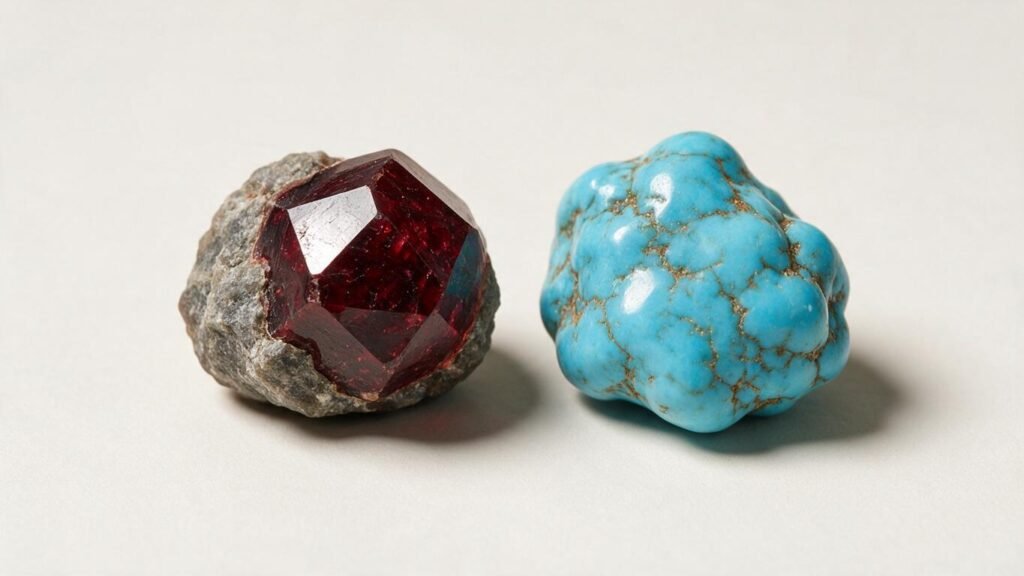
Nofekh — the fourth of the twelve ancient stones
Ten of the twelve stones are arguments about degree. Scholars disagree about which green, which red, which variety.
This one is an argument about the opposite ends of the spectrum.
Follow the Greek and you arrive at a burning red. Follow the Egyptian and you arrive at a pale blue-green.
נֹפֶךְ — Nofekh is the only stone on the breastplate where the two leading readings are not neighbours. They are opposites. And rather than pick one and move on, this essay is about the disagreement itself, because the disagreement is the more interesting object.
1. Two Roads Out of One Word
The Septuagint translates Nofekh as anthrax — a live coal, the ember at the heart of a fire. The Vulgate follows with carbunculus, “little coal.” Both point to a deep red stone, almost certainly what we would now call garnet.
That is the first road, and it is well travelled. It gave English the word carbuncle, which meant a red gem for centuries before it meant anything medical.
The second road starts in Egyptian. The word mfkꜣt — conventionally vocalised mefkat — names the blue-green material the Egyptians mined in the Sinai and prized above almost anything: turquoise, and sometimes malachite. A number of scholars have proposed that Hebrew nofekh is a loan from it.
Phonetically the case is respectable. Historically it is more than respectable: Egypt is where the Israelites are described as having come from, and Egyptian loanwords are scattered through the vocabulary of Exodus.
Ezekiel adds a third data point without resolving anything. He lists nofekh among goods traded into Tyre, alongside textiles and coral — which tells us it was a commodity moving along known routes, and nothing at all about its colour.
So we have a Greek tradition saying fire and an Egyptian etymology saying sky, and no way to reconcile them. In one line of interpretive tradition the stone is associated with Judah; as ever, the biblical text makes no such assignment, and the commentators do not agree.
2. Two Materials
The two candidates could hardly be less alike, and the contrast is instructive.
Garnet is a family rather than a single mineral — almandine, pyrope, spessartine and others, sharing a crystal structure and differing in chemistry. It is hard, 7 to 7.5, and singly refractive, which gives cut stones a particular directness: light goes in and comes back without being split.
It is also one of the few gems that is genuinely common. Garnet sand exists. Garnet is used as an industrial abrasive. Its ordinariness in the modern world has almost erased how seriously it was once taken.
Turquoise is the opposite in every respect. A hydrated copper aluminium phosphate, it is soft — 5 to 6 — porous, and chemically fragile. Skin oils change it. Cosmetics stain it. Sunlight can green it.
It is the only major gemstone that visibly ages on the person wearing it. A turquoise passed down through a family is not the stone it was, and in several of the cultures that value it most, that shift is considered part of the point rather than damage.
3. Fire: The Garnet Road
Red garnet had a moment of extraordinary reach in late antiquity, and it is one of the most remarkable trade stories in this collection.
Across Europe between roughly the fourth and seventh centuries, goldsmiths produced a style now called cloisonné: thin gold walls soldered onto a base, each compartment filled with a slice of flat red garnet, backed with patterned foil to make it glow.
The workmanship is extraordinary. The provenance is more so.
Scientific analysis of garnets from these objects — including the celebrated pieces from the Sutton Hoo ship burial in England — points to sources in India and Sri Lanka.
Which means that at a moment when western Europe is conventionally described as fragmented and inward-looking, its most prestigious objects were being made with stone carried halfway across the world.
The jewellery knew things the history books had to catch up with.
4. Sky: The Turquoise Road
Turquoise runs through an entirely different geography.
The Egyptians mined it in the Sinai at Serabit el-Khadim, in expeditions organised by the state — not casual prospecting but a sustained operation with permanent structures, sent out season after season for a stone.
Further east, the deposits around Nishapur in Persia produced the material that gave the stone its Persian name, fīrūzah, and a place in Islamic decorative art that it has never lost. Turquoise sets the tone of an entire visual tradition — the domes and tilework of Central Asia read as turquoise even when the glaze chemistry is something else. The stone named a colour, and the colour named an architecture.
The English word arrived by a different route again: turquoise is simply French for “Turkish”, because the stone reached Europe through Turkish trade rather than from any Turkish mine. A misattribution that stuck for eight hundred years.
5. Two Symbolisms, One Word
Here is where the disagreement stops being an inconvenience and becomes the subject.
Red, in the cultures that used garnet, was associated with blood, with life, with fire, with ardour. Warriors were buried with it.
Turquoise, in the cultures that used it, was associated with the sky, with water, with protection — and specifically with protection in transit. It was the stone of travellers, fixed to bridles and harnesses, carried on journeys.
So the same three consonants in the same verse have been understood to mean the hottest thing in the palette and the coolest. Ardour and protection. The fire and the horizon.
It is a useful reminder of how much interpretation sits between us and an ancient text — and how easily a translator’s single choice becomes, three centuries later, a fact everyone repeats.
6. Both Stones in Contemporary Jewellery
Both have had recent returns, for opposite reasons.
Turquoise came back through design. The 1970s took it seriously — big cabochons, yellow gold, deliberately graphic settings — and that vocabulary has been revisited repeatedly since. Its matrix, the dark veining of host rock left in the stone, moved from defect to signature, much as inclusions did for emerald.
Garnet came back through rarity. Not the common red material, but the green demantoid from the Russian Urals, whose fine internal fibres — the trade calls them horsetails — are prized as a mark of origin, and the orange spessartine from Namibia and Nigeria. Demantoid disperses light more strongly than diamond, a fact almost no one outside the trade knows.
The family that supplies industrial abrasive also supplies one of the most sought-after coloured stones in the world. Few materials cover that range.
7. What Makes It Distinctive
Every other stone in this collection has a story that resolves.
This one does not, and it is more useful for it.
Nofekh is a standing demonstration that the twelve are not a solved list — that somewhere in the transmission, between a Hebrew scribe and a Greek translator working in Alexandria, a decision was made that we can no longer see, and everything downstream inherited it.
There is a temptation, in writing about historical objects, to smooth this over: to choose the likelier reading, state it plainly, and let the reader assume the matter is closed. It reads better. It is also how a translator’s guess hardens into a fact.
We would rather show the seam.
8. A FEDIYAR Note
Certainty is a pleasant thing to sell and a poor thing to promise.
What a serious buyer eventually learns is that provenance is rarely a clean line. It is a chain of documents, attributions and judgements, each made by someone with partial information, and the honest version always has a gap in it somewhere.
The dishonest version does not — which is precisely what should make you look twice.
Nofekh has been unresolved for two thousand years, in a text that has been read more closely than almost any other. That is not a failure of scholarship. It is what a real record looks like when nobody has tidied it up.
FEDIYAR
The most trustworthy histories are the ones that admit where they stop.
A story without a gap in it has usually been repaired.
Previously: Bareqet — a word that means lightning.
Related: Lapis lazuli — the blue that was never a sapphire · Leshem — the stone nobody can name.
A note on method: throughout this collection we distinguish three things — what the ancient text actually says, what later traditions made of it, and what modern mineralogy proposes. Where an identification is debated, we say so.


