Shoham — the eleventh of the twelve ancient stones
Most of what we say about these stones is reconstruction. We work backwards from a Greek translation, a Latin one, a mineral that might fit.
This one is different, and it is the only place in the passage where the text tells us what a stone was for.
Before Exodus describes the breastplate at all, it describes two other stones — set on the shoulders of the high priest’s garment, engraved with the names of the sons of Jacob, six on each. Those two stones are called שֹׁהַם — Shoham. The same name then appears again among the twelve.
The text does not say what colour it was. It says, twice, that this is the stone you write names on.
1. The One Thing We Know
What Shoham actually was remains unsettled, and the versions pull in different directions.
The Septuagint gives bēryllion in one place and onychion in others. The Vulgate offers onychinus and beryllus. Onyx, sardonyx, beryl, malachite, chrysoprase and lapis have all been argued for, and the collection is by now familiar with this kind of impasse.
Genesis adds a geographical hint, placing good shoham in the land of Havilah — a region the text does not locate in any way we can use.
But the functional description is unambiguous, and it is repeated. Whatever the mineral, it was chosen because it could be engraved, held fine detail, and kept a name legible.
That narrows the field more usefully than any etymology. It rules out anything too hard for period abrasives, anything too soft to hold an edge, and anything too fractured to survive the work.
In one line of interpretive tradition Shoham is associated with Joseph. The biblical text makes no such assignment, and the commentators do not agree.
2. The Oldest Luxury Craft
Gem engraving is older than most things we call ancient.
By the fourth millennium BCE, Mesopotamian workshops were producing cylinder seals — small stone cylinders carved in reverse, meant to be rolled across a tablet of wet clay so that the design emerged as a continuous frieze in relief.
Think for a moment about what that requires.
The carver worked in negative, on a curved surface, at a scale of a few centimetres, producing an image that would only ever be seen inverted and unrolled. He could not check his work by looking at it. He had to hold the finished impression in his head and cut its opposite.
And these were not simple marks. The good ones carry figures, animals, inscriptions, whole scenes with depth and overlap.
The cylinder seal is arguably the first object in history that is simultaneously a signature, a work of art, and a piece of legal infrastructure.
3. How It Is Actually Done
The tools have changed less than you would expect.
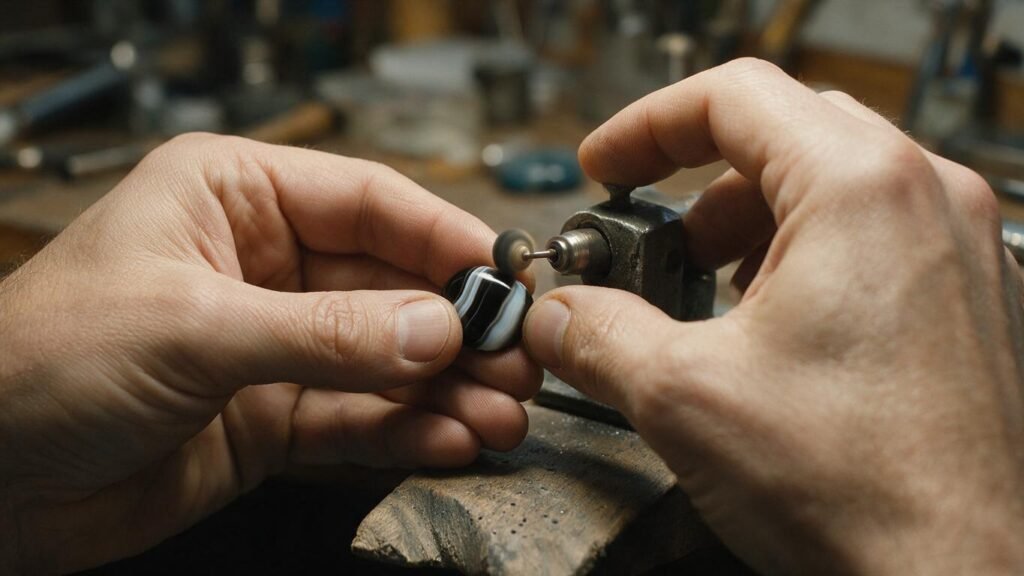
The engraver does not hold a knife. He holds the stone, and presses it up against a small rotating tool — a disc, a point, a ball — mounted on a spindle turning in front of him. Historically a bow drill, then a treadle, now an electric motor.
The tool itself does not cut. It carries abrasive: emery or corundum powder in oil for most of history, diamond powder today.
Everything is done in reverse. The design is cut in intaglio, sunken into the surface, so that the impression it makes in wax stands up in relief. Left becomes right. A letter must be cut backwards. Depth must be judged for its effect on a surface that does not yet exist.
The engraver is shaping an absence, and judging it by imagining its opposite.
There is no undo. Material removed is gone, and a slip at the end of a week’s work ends the week’s work.
4. Where Traditions Meet
The craft moved along the same routes as the stones.
Greek and Roman glyptic produced work of astonishing refinement, and — unusually for antiquity — some of it is signed. Pliny records that Alexander restricted the right to engrave his likeness to a single artist. Augustus is reported to have used a gem cut by a named engraver as his own seal. These are among the earliest named individual artists whose actual works survive.
In the Islamic world the engraved stone became the seal ring, carried on the hand, cut with a name, a title or a line of verse, and used to authenticate documents and correspondence for centuries. The engraver of seals was a recognised profession with its own standing.
In China and India the traditions developed separately, around different materials and different scripts, toward the same end: a small hard object that could put a specific person’s mark onto a document.
Four civilisations, no coordination, one conclusion — that identity should be entrusted to carved stone.
5. What a Name in Stone Has Been Made to Say
To engrave a name is to make a claim about duration.
Writing on a surface intended to outlast you is a different act from writing on one that will not, and every culture that did it seems to have understood the difference. Seals were buried with people. They were destroyed deliberately when a person’s authority ended. They were inherited, and inheriting one meant inheriting the right to act as its owner.
There is also something more particular here, and it belongs to this passage specifically. The stones are described as carrying names, and as being worn on the shoulders — carried by someone, on behalf of others, into a place those others could not go.
Whatever one makes of the theology, the design idea is exact: a portable, durable record of who is being represented, worn by the person doing the representing.
6. The Craft Today
Hand gem engraving is close to disappearing, and it is worth being specific about what that means.
There are perhaps a few dozen people worldwide working at the highest level. The training takes years, and produces a skill with a narrow market. Machine engraving and laser marking handle most commercial work, and handle it well.
What machines do not produce is the particular quality of a cut made by someone making decisions continuously — varying the depth for the way light will fall, leaving a line slightly heavier where it needs to read at a distance, stopping a hair short of where the design says to stop.
The signet ring is where this survives commercially. It came back into fashion, quietly, over the past decade, and with it a small revival of demand for hand-cut stones and hand-cut monograms.
If you want to know what this collection means by savoir-faire, this is it: a technique four thousand years old, held by very few people, producing something a machine can approximate but not replace.
7. What Makes It Distinctive
Every other stone here is interesting for what it is. This one is interesting for what was done to it.
And it is the only one whose purpose the ancient text bothers to state. The others are listed. This one is explained.
That tells us something about the hierarchy of values in the world that produced the passage. The stone mattered less than the name it carried. It was chosen as a support — the best available material for holding a mark — and the mark was the point.
Which is, when you think about it, an unusually modest idea about a precious object. The gem is infrastructure.
8. A FEDIYAR Note
The objects that hold their value over generations are almost never the ones that were merely expensive.
They are the ones that were made for someone, by someone, with a decision in every millimetre — and that carry evidence of both.
A hand-cut monogram is worth more than a laser-cut one for a reason that has nothing to do with the material. Somebody spent forty hours making a series of judgements about how light would fall on a surface the size of a fingernail, on behalf of one person, and that will still be visible in two hundred years.
That is the whole argument, and it fits on a ring.
FEDIYAR
The gem was never the point.
The point was that someone had a name, and someone else knew how to cut it.
Previously: Tarshish — named for a port at the edge of the map.
Related: Carnelian — the stone that accepts a name · Yahalom — the stone named for a blow.
A note on method: throughout this collection we distinguish three things — what the ancient text actually says, what later traditions made of it, and what modern mineralogy proposes. Where an identification is debated, we say so.


