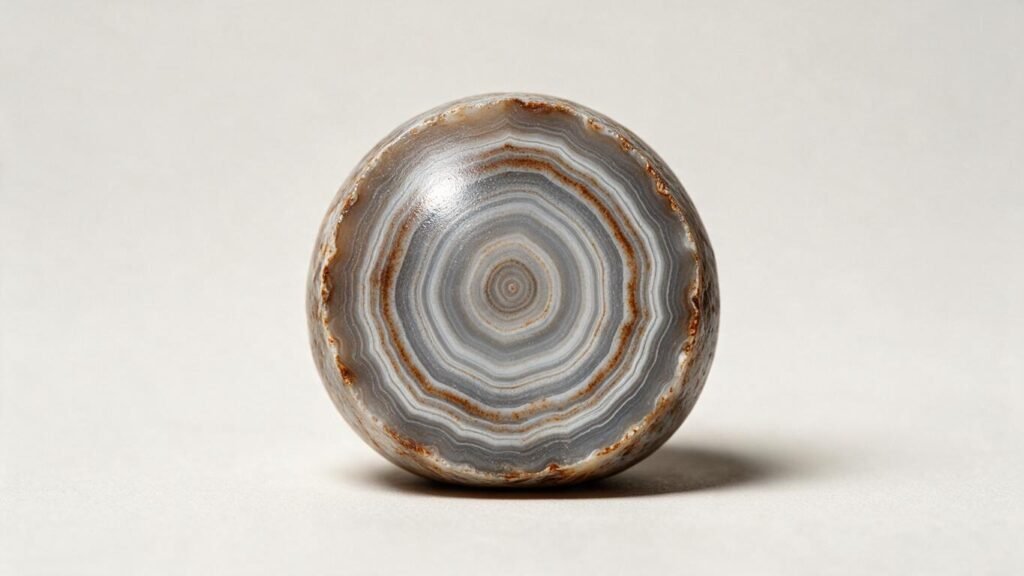
Agate — Shevo, the eighth of the twelve ancient stones
Split an agate nodule and you are looking at a record.
The bands are not decoration. Each one is a layer of silica that came out of solution and stopped, then waited, then was followed by another with a slightly different chemistry — a different iron content, a different rate, a different temperature in the rock.
The stone is a stack of interruptions.
Which makes שְׁבוֹ — Shevo the only entry in the breastplate that carries a legible account of how it was made. Everything else here is a colour or a hardness. This one is a sequence of events.
1. A Name from a River
The Septuagint gives achates. The Vulgate follows. Both are the origin of the English word.
Theophrastus reports the source, and Pliny repeats it: the stone was first found in Sicily, in a river called the Achates, and took its name from the place. Ancient geography is not always reliable on such points, but the attribution is old and consistent, and there is nothing implausible about it.
The Hebrew Shevo is harder. Its etymology is obscure, and one proposal connects it to Sheba — the south Arabian kingdom that appears in the biblical text as a source of luxury goods — which would make it a trade name rather than a description. That is speculation, and should be treated as such.
What can be said is that the identification of Shevo with agate is one of the steadier ones in the list. The versions agree, and agate was abundant, workable and everywhere in the ancient Near East. It is the kind of answer that is boring precisely because it is probably right — a welcome change in a collection largely composed of arguments.
In one line of interpretive tradition Shevo is assigned to Naphtali. The biblical text makes no such assignment, and the commentators do not agree.
2. How a Band Happens
Agate forms in cavities — gas bubbles in cooling lava, voids in sedimentary rock. Silica-bearing fluid enters, deposits a layer on the wall, and the conditions change.
Change them again and you get another layer. Repeat for a very long time.
The bands follow the shape of the cavity, which is why they curve: they are not stripes laid on a flat surface but successive skins on the inside of a hollow, like the layers of an onion turned outward.
Colour comes from whatever was dissolved in the fluid at the time — iron for red and brown, manganese for grey and violet, organic traces for the darker tones.
The banding is where agate parts company with its relatives. Carnelian, which opened this collection, is the same mineral: microcrystalline silica, chalcedony. What separates them is that carnelian is uniform and agate is stratified.
One hides its formation. The other cannot stop describing it.
3. The Craft That the Bands Made Possible
Because the layers are distinct, and because they sit in parallel, a carver can do something with agate that no single-coloured stone permits.
Cut down through a pale band into a dark one and the figure stands out in white against a black ground, without any pigment, without any joins — one piece of stone in two colours.
This is the cameo, and its great period was Rome.
The large imperial cameos in sardonyx — the layered brown-and-white variety — are among the most technically demanding objects to survive from antiquity. Some carry multiple figures on several planes. The carver had to know, before making the first cut, exactly how deep each colour ran through material he could not see into.
There is no correcting a mistake. Remove too much and the colour beneath appears in the wrong place, permanently.
It is one of the few crafts where the material dictates the composition entirely, and the artist’s skill lies in reading the stone before touching it.
4. Where Traditions Meet
Agate travelled into the Islamic world through the same channel as its cousin carnelian, and under the same name: ‘aqīq, the Arabic term that covers this family of stones.
There it became above all a seal stone and a ring stone — engraved with a name or a phrase, set in silver, worn on the hand. Yemeni material in particular acquired a standing that it has not lost.
The banded varieties carried a second use. A band running through a cabochon gives the stone an eye, and eye-agates have been worn as protective objects across a very wide geography — Mesopotamia, the Indus, the Mediterranean, the Islamic world — by cultures with no contact with one another.
The reasoning is not mysterious. A stone that appears to look back at you is doing something no other mineral does, and several traditions independently decided that was useful.
5. What the Band Has Been Made to Say
If agate has a consistent meaning across cultures, it is not about colour. It is about the visible accumulation of time.
A banded stone shows that it was built slowly, in stages, by a process that stopped and started. Cultures that noticed this tended to read it as patience, continuity, or the layering of a life.
There is also a more modern reading that belongs to the collector rather than the philosopher: agate is where you learn that no two pieces of a material can be identical. Not similar, not near-identical — genuinely, verifiably unique, because the sequence that produced each one happened once.
That is now an argument people pay for. It did not use to be.
6. Idar-Oberstein, and the Honest Question of Dye
The German town of Idar-Oberstein has cut agate since the Middle Ages, on local deposits and local water power.
By the nineteenth century the local material was exhausted, and the town should have ended there. Instead, emigrants from the region who had settled in Brazil found enormous agate deposits and began shipping the rough back to Germany.
Idar-Oberstein became the cutting centre of the world on stone from another continent — a cluster of skill that outlived its own raw material. It remains one of the most instructive stories in the trade about where value actually sits.
The same town perfected something else that buyers should understand. Agate is porous, and it takes dye. The bands absorb unevenly, which means dyeing produces strong contrast along the existing structure — blue agate, green agate, the intense black-and-white of much commercial onyx.
This is a legitimate, centuries-old treatment. It should also be disclosed, and in a serious market it is. A buyer who knows the stone was dyed is getting what they paid for. One who does not, is not.
7. What Makes It Distinctive
Most gemstones are valued for consistency: a colour that matches across a set, clarity that holds from stone to stone, a cut that can be reproduced.
Agate cannot be consistent. Matching two slices is an act of luck, and any object using several of them is a negotiated compromise between the maker and the material.
Which makes it, quietly, the most contemporary stone in this collection. Everything about current luxury — the single edition, the traceable object, the piece that cannot be repeated — describes agate exactly, and has done since the Romans.
It just took the market four thousand years to want what the stone was always doing.
8. A FEDIYAR Note
There is a difference between an object that is rare and an object that is unrepeatable.
Rarity is a quantity. Enough capital and enough patience will generally find you another one.
Unrepeatability is structural. The sequence that made this particular stone — the fluid, the pause, the change in the rock — happened once, in one cavity, and no process available to anyone will produce it again.
Most of what we call unique is really just scarce. Occasionally something is genuinely singular, and it is usually the material itself that decided so, long before anyone was there to price it.
FEDIYAR
Rare means there are few.
Unrepeatable means there was one, and the conditions have gone.
Previously: Leshem — the stone nobody can name.
Related: Carnelian — the stone that accepts a name · Jasper — one word, two different stones.
A note on method: throughout this collection we distinguish three things — what the ancient text actually says, what later traditions made of it, and what modern mineralogy proposes. Where an identification is debated, we say so.


