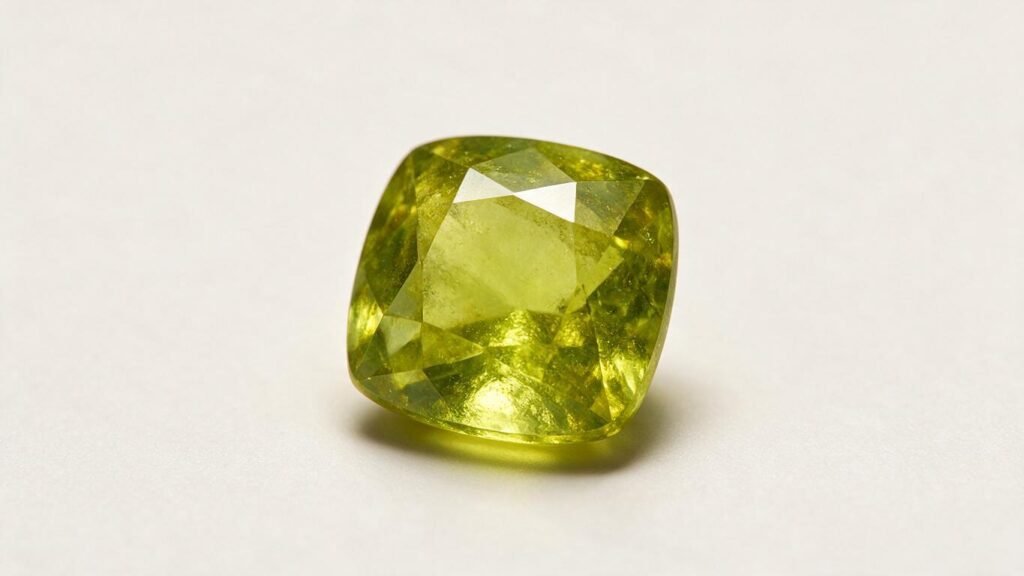
Peridot — Pitdah, the second of the twelve ancient stones
There is a stone whose name means, more or less, keep looking.
Pliny the Elder explains why. The gem came from a small island in the Red Sea, and the island was almost always lost in haze. Sailors knew it was out there. Finding it was another matter.
In the language of the Troglodytae who worked that coast, he writes, the word topazin meant to seek. The stone took the name of the search rather than of the place.
It is the only one of the twelve named after a difficulty.
1. A Name That Points to the Wrong Stone
In the Hebrew of the Book of Exodus, the second stone of the high priest’s breastplate is called פִּטְדָה — Pitdah.
The Septuagint renders it topazion. The Vulgate follows with topazius.
Which is where the trouble begins — and it is the kind of trouble this collection of twelve essays exists to untangle.
Topazos, in the ancient world, was not the mineral we call topaz today.
Pliny describes it closely enough to settle the matter. He calls topazos the largest of the precious stones, and the only one of high value that yields to the file.
Modern topaz is 8 on the Mohs scale. A file will not touch it.
Peridot sits at 6.5 to 7. A file will.
Everything else agrees: the island, the Red Sea, the green, the softness. The stone the ancients called topaz is, in all likelihood, the one we call peridot.
The Book of Job speaks of “the topaz of Cush” — the region south of Egypt, on the same stretch of coast. The geography lines up with Pliny.
The Hebrew Pitdah itself resists us. Some connect it to a Sanskrit word for yellow, others to Assyrian. None of it is settled, and it would be dishonest to present it as though it were.
In one line of interpretive tradition, this stone is associated with Simeon, the second son of Jacob. The text makes no such assignment. Exodus gives twelve stones and twelve names, and stops there. The pairings come from later commentary, and the commentators do not agree with one another.
2. The Material
Peridot is gem-quality olivine — a magnesium iron silicate, one of the most abundant minerals inside the Earth and one of the less common ones on its surface.
Its colour is not an accident of impurity.
In most gems, colour arrives as a trace of something that does not belong: chromium in an emerald, iron in an aquamarine. Remove the trace and the stone is colourless.
Peridot’s green is built into its own structure.
Which means it has no other colour. There is no white peridot, no blue peridot, no red one. Every peridot that has ever existed is green, somewhere between olive and a clear yellow-green, and that is the whole range.
Very few gems can say as much.
At 6.5 to 7 on the Mohs scale it is wearable, but not indifferent. It dislikes sudden heat and acid. Its lustre is faintly oily rather than glassy.
And it is strongly doubly refractive. Look into a cut peridot through the table and the back facet edges appear twinned — as though the stone had been drawn twice, by a slightly unsteady hand.
3. An Island That Did Not Want to Be Found
The island is real. It lies off the Egyptian coast in the Red Sea, and it is called Zabargad today — St John’s Island on the old British charts.
Pliny tells the discovery as a shipwreck story. Troglodyte pirates, driven ashore by a storm and starving, dug for roots and found the stone instead.
Like most ancient origin stories, it is probably too neat.
What is not in doubt is that Egyptian workings there are very old, and that for most of antiquity this single island supplied the Mediterranean with a green gem nobody else could produce.
A second account has been repeated since: that the stones were nearly invisible against that glaring ground by day, so the miners marked their positions at night, when the gems held what little light there was, and dug them out in the morning.
Whether or not it happened, it is the kind of story that attaches itself to a stone that behaves strangely in low light — which, as we are about to see, it does.
The island was worked, abandoned, rediscovered and worked again across the centuries. It is essentially finished now. Peridot today comes from Pakistan, Myanmar, China, and an Apache reservation in Arizona.
4. Where Traditions Meet
The Arabic world named this stone twice, and both names stuck.
Zabargad, the island’s modern name, is the Arabic word for the gem itself — the place now carries the name of what came out of it.
And “peridot” is generally traced to the Arabic faridat, meaning simply gem: the ordinary word that narrowed, over centuries, to mean this one.
Then there is Cologne.
The most famous peridots in the world spent seven hundred years being admired as something else.
The Shrine of the Three Kings in Cologne Cathedral — the great gilded reliquary begun in the twelfth century — carries a set of large green stones, some of them around two hundred carats. They were recorded as emeralds. Generations of pilgrims saw emeralds.
They are peridots. Almost certainly from Zabargad, carried west along the routes that ran through the Levant.
It is a useful reminder. For most of history a green stone was identified by its colour and its size, not by its species. Emerald was a description long before it was a mineral — a point we return to in the essay on Bareqet, the stone whose name means lightning.
5. What Green Has Been Made to Say
Green is the colour cultures reach for when they want to speak about what continues. Growth, water, the return of a season.
But peridot’s green is not that green. It carries too much yellow.
Set beside an emerald it looks lit from a different source — warmer, less cool, less imperial. Across various traditions it has been associated with light rather than with growth, and often with protection, though the traditions that say so do not agree on why.
What can be said without argument is that this is a green that refuses to be pure.
Its yellow is not a flaw in the colour. It is the colour.
6. Jewellery After Dark
Here is the practical fact that decides how peridot is used.
Under candlelight — and later under electric light — emerald goes quiet. Its blue-green loses its footing and the stone darkens.
Peridot does the opposite. Its yellow-green holds. It stays bright when the room does not.
Nineteenth-century Europe noticed, and gave it a name: evening emerald.
That is not a poetic flourish. It is a specification. It tells a jeweller when the stone is at its best, and the answer is dinner, not daylight.
Set in yellow gold it does something unusual. It does not contrast with the metal — it continues it. The gold appears to carry on into the stone and turn translucent.
Peridot has never commanded high prices, and that is precisely why it rewards attention. In a market where four or five stones absorb most of the money, this is where a designer can still work at scale: large, clean, well-cut material, for a fraction of what the same visual presence costs in emerald.
7. What Makes It Distinctive
Every stone in this collection so far has come from the Earth’s surface — formed in cavities, in veins, in the upper crust.
Peridot has not.
Olivine is a mantle mineral. It forms tens of kilometres down, under pressures nothing at the surface reproduces, and it reaches us only because volcanic activity carries it upward faster than it can break down on the way. A peridot in a ring has already made one improbable journey before anyone thought to mine it.
And some of it never came from this planet at all.
Olivine occurs in pallasite meteorites — a rare class in which green crystals sit suspended in a matrix of iron and nickel. They are fragments of the boundary between the core and the mantle of a body that came apart. Instruments have found olivine on Mars, on the Moon, and in the dust of a comet.
It is the one stone on the breastplate that is demonstrably not a purely terrestrial material.
8. A FEDIYAR Note
Some things are valuable because they are scarce. Others because they are difficult to reach.
Peridot has never been scarce. There is more olivine inside this planet than almost anything else.
What made it precious was distance — a mantle that had to erupt, an island that had to be found, a sea that had to be crossed by people who were not always sure where they were going.
None of that is visible in the finished stone. You cannot see, in a green oval on a hand, that it began beneath the crust and arrived on a boat from a place nobody could reliably locate.
That is usually how it works. The journey does not show.
It is simply the reason the thing is here at all.
FEDIYAR
Some objects are rare. Others are simply far away.
The distance travelled is seldom visible in what finally arrives.
Previously in the collection: Carnelian — the stone that accepts a name.
Next: Shoham — the stone chosen to be written on.
A note on method: throughout this collection we distinguish three things — what the ancient text actually says, what later traditions made of it, and what modern mineralogy proposes. Where an identification is debated, we say so.


