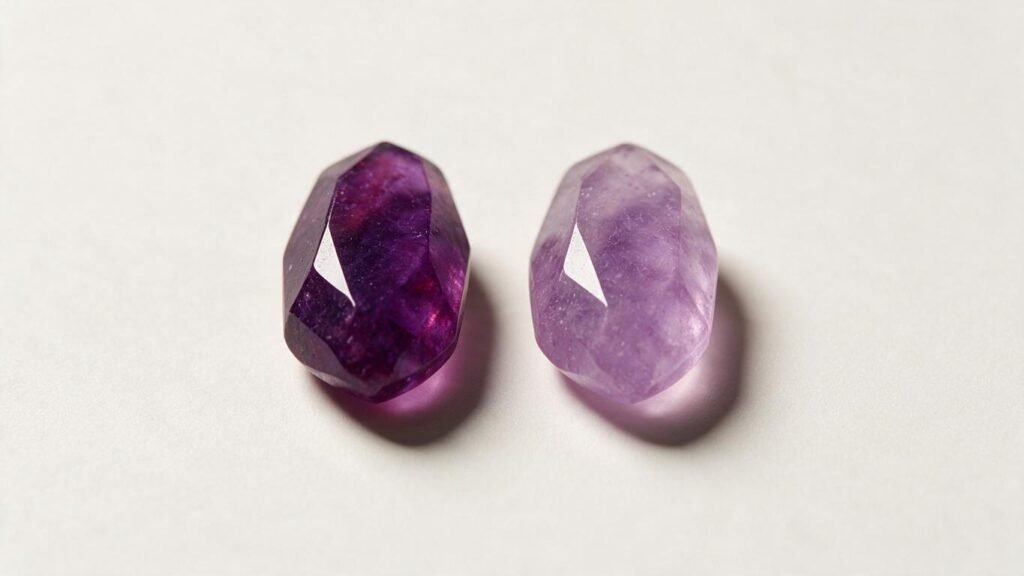
Amethyst — Achlamah, the ninth of the twelve ancient stones
For most of recorded history, amethyst was a precious stone. It sat with emerald, ruby and sapphire, in the short list of materials that a serious jeweller treated as serious.
Then, in the nineteenth century, it stopped.
Nothing about the stone changed. No new treatment devalued it, no fashion turned against it. What happened was geological: large deposits were found in South America, and within a generation the supply of amethyst went from constrained to effectively unlimited.
This essay is about that, because it is the clearest case in the collection of value being a fact about circumstances rather than about a material.
1. The Name and the Drinking
The Septuagint gives amethystos. The Vulgate follows with amethystus.
The Greek reads as a-methystos — not drunken — and the associated belief is that the stone protected its owner from intoxication. Cups were carved from it. Roman dinner guests wore it.
The likely explanation is prosaic and rather good: the stone is the colour of diluted wine. A vessel of amethyst makes water look like wine and wine look like water, and a guest could appear to keep pace with the table without doing so. The etymology may well have followed the practical joke rather than preceding it.
The Hebrew אַחְלָמָה — Achlamah is less clear. A common suggestion links it to the root ḥ-l-m, to dream, which would give a lovely reading — a stone of dreams — and which is almost certainly a folk etymology rather than a derivation. Others have proposed Egyptian sources. Nothing is settled.
The identification with amethyst itself is reasonably solid. The versions agree, the colour is distinctive, and amethyst was demonstrably available: the Egyptians mined it at Wadi el-Hudi, in the Eastern Desert, in organised expeditions during the Middle Kingdom.
In one line of interpretive tradition the stone is associated with Gad. The biblical text makes no such assignment, and the commentators do not agree.
2. The Material
Amethyst is quartz. Chemically it is the same silicon dioxide as the sand on a beach and the rock crystal in a chandelier.
Its colour comes from an unusual mechanism: traces of iron built into the structure, altered by natural irradiation from the surrounding rock over geological time. Iron alone gives you nothing. Irradiation alone gives you nothing. The colour requires both, in sequence.
Heat undoes it. Warm most amethyst sufficiently and the purple turns yellow-orange — which is to say it becomes citrine. The great majority of citrine on the market is heated amethyst, and always has been.
That one material becomes another with the application of an oven is worth sitting with. Two stones with different names, different symbolism and different prices are the same crystal at different temperatures.
Amethyst is 7 on the Mohs scale, durable enough for daily wear, and prone to colour zoning — the purple often concentrated in bands or at the crystal tip, which is why cutting amethyst well is a matter of orienting the stone so the colour reads evenly from the top.
3. Purple Before Chemistry
To understand what amethyst meant, you have to understand what purple cost.
The purple of antiquity came from marine snails, processed in enormous quantity — thousands of animals for a small amount of dye — in coastal workshops whose smell was legendary. The resulting cloth was worth more than its weight in precious metal.
Rome regulated who could wear it. Byzantium went further, reserving the deepest shades for the imperial house; an emperor’s child born during the reign was described as born in the purple, and the phrase survives in English with its original meaning intact.
So purple was not merely a colour that people liked. It was a controlled substance, legally restricted, and visible at a distance.
Amethyst was the mineral form of that. A hard, permanent, wearable piece of the one colour that money alone was not always enough to obtain.
Its long association with the church in medieval Europe — the bishop’s ring, the stone of prelates — belongs to the same logic. Purple was the colour of rank before it was the colour of anything else.
4. Where Traditions Meet
Beyond the Mediterranean, amethyst circulated as one of the standard stones of the Persian and Indian lapidary traditions, though rarely with the top billing it enjoyed in Europe. Its position in any given culture depended almost entirely on what purple meant there.
That is the point worth carrying away. Amethyst’s status was never really about the stone. It tracked the local status of the colour, which in turn tracked the difficulty of producing that colour in textiles.
Where purple cloth was restricted, the purple stone was precious. Where it was not, the stone was pleasant.
Few materials demonstrate so clearly that a gem’s meaning is borrowed from the world around it.
5. What Purple Has Been Made to Say
Purple sits between red and blue, and its symbolism has generally borrowed from both — the warmth and urgency of one, the depth and distance of the other.
Cultures that have written about it tend to reach for words about the mixed state: twilight rather than day or night, the moment of transition, the reflective hour.
In European traditions it acquired an association with contemplation and with restraint, partly through its ecclesiastical use and partly through the older Greek idea of sobriety in the face of wine.
What can be said without dispute is that purple is the rarest colour in the natural world at any scale. There are few purple flowers compared to yellow ones, almost no purple animals, and no purple landscape. A mineral that produced it reliably was doing something the world around it largely could not.
6. What Brazil Changed
The deposits found in Brazil and Uruguay in the nineteenth century were not a new source. They were a different order of thing — geodes by the tonne, cavities large enough to stand inside, material of good colour in quantities that no European market had ever contemplated.
The price collapsed. Amethyst moved, in the working vocabulary of the trade, from precious to semi-precious, and it has stayed there.
The interesting part is what did not change.
A fine amethyst — deep, even, slightly red-toned, the material the trade once called Siberian after its best source — is still rare, still difficult to find in size, and still beautiful. What disappeared was not the quality. It was the guarantee that anyone wearing purple had paid dearly for it.
The stone lost its function as a signal, and the market priced the signal, not the stone.
7. What Makes It Distinctive
Every other essay in this collection has argued, in one way or another, that a material’s value has reasons — origin, difficulty, craft, singularity.
Amethyst is the counter-example, and a collection without one would be propaganda.
Here is a stone whose beauty, durability and history are entirely unchanged, and whose standing fell through the floor for reasons that had nothing to do with any of them. Scarcity was doing the work. When scarcity left, the rest was not enough to hold the position.
That is not a comfortable observation for anyone in the business of selling rare things. It is, however, true, and it is better understood than avoided.
8. A FEDIYAR Note
The useful question amethyst leaves behind is this: if the price of something halved tomorrow, and nothing about the object itself had changed, would you still want it?
For a great many things, honestly, the answer is no — and there is no shame in it. Part of what people buy is legibility, the fact that others will recognise what they are looking at. That is an ancient and perfectly human motive.
But it is worth knowing which of the two you are doing. An object wanted for itself survives a collapse in its market. An object wanted for what it signalled does not.
Amethyst is still exactly as beautiful as it was in 1750. The only thing that stopped was the applause.
FEDIYAR
Ask what you would still want if nobody could tell what it cost.
That answer is the part of the object that belongs to you.
Previously: Agate — no two alike.
Related: Bareqet — a word that means lightning · Tarshish — named for a port at the edge of the map.
A note on method: throughout this collection we distinguish three things — what the ancient text actually says, what later traditions made of it, and what modern mineralogy proposes. Where an identification is debated, we say so.


