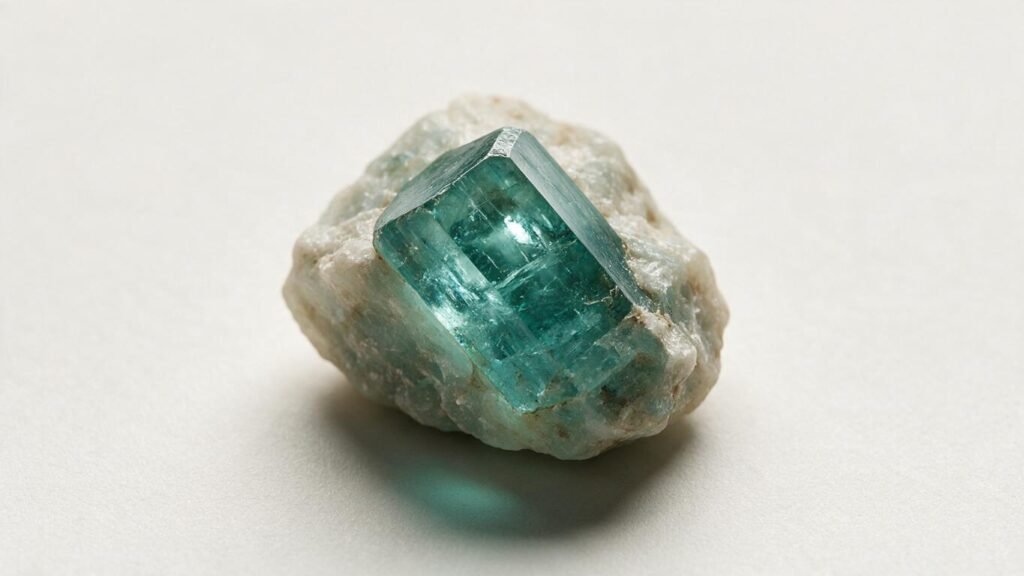
Bareqet — the third of the twelve ancient stones
Most gem names describe a colour, a place, or an owner.
This one describes an event.
בָּרֶקֶת — Bareqet is built on the root b-r-q, which in Hebrew means lightning. The same root runs through Arabic, where barq is the flash in a storm cloud. The word does not tell us the stone was green. It tells us the stone threw light.
Everything difficult about this entry in the breastplate follows from that.
1. A Name That Describes Light, Not Colour
The Septuagint renders Bareqet as smaragdos. The Vulgate follows with smaragdus. Both are the ancestors of the modern word emerald.
Which looks like a clean answer, and is not one.
Smaragdos in Greek was not the name of a mineral. It was a category — a bag into which ancient writers put emerald, green beryl, malachite, green jasper, chrysocolla, green marble and, on occasion, coloured glass. Pliny lists a dozen kinds of smaragdus and is openly sceptical about several of them.
So the chain runs: a Hebrew word about brightness, translated by a Greek word about greenness in general, translated again by a modern word for one specific mineral. Each step lost something. This is the pattern the whole collection of twelve essays keeps running into.
There is a chronological problem as well. The emerald mines that supplied the Mediterranean — in Egypt’s Eastern Desert, a zone the Romans called Mons Smaragdus — appear to have been worked from the Ptolemaic period onward. For anything earlier, emerald is a difficult candidate on grounds of supply alone.
A related Akkadian word, barraqtu, names a green stone, and some scholars have connected it in turn to Sanskrit marakata. The trail is suggestive rather than settled.
The honest conclusion is a narrow one. Bareqet was a bright green stone. Which green stone, nobody can say with confidence.
In one line of interpretive tradition it is associated with Levi, the third son of Jacob. The biblical text makes no such assignment; the pairings belong to later commentary, and the commentators disagree among themselves.
2. The Material
If we follow the tradition and read Bareqet as emerald, we are looking at beryl — a beryllium aluminium silicate, colourless in its pure state.
Emerald is what happens when chromium or vanadium finds its way into that structure.
This is a geological improbability. Beryllium concentrates in the light rocks of the upper crust; chromium belongs to the heavy, deep rocks. They have no ordinary reason to meet. Emerald exists only where some violent event forced two incompatible chemistries into the same space.
That accident is also why emerald behaves the way it does.
It is hard — 7.5 to 8 on the Mohs scale — but it is not tough. It grows fractured, full of the fissures and mineral guests that the trade calls, without embarrassment, the jardin.
Nearly every emerald on the market has had oil or resin worked into those fissures to make them less visible. This is normal, ancient, and must be disclosed. It is one of the few places in the gem world where an accepted treatment is discussed openly rather than hidden.
3. Three Sources, Three Worlds
Egypt came first. The Eastern Desert workings at Sikait and Zabara produced small, cloudy, heavily included stones — nothing that would satisfy a modern buyer, and enough to supply an empire that had no alternative.
Then, in the sixteenth century, Spanish ships began arriving from the New World with emeralds that made the Egyptian material look like gravel.
The Colombian deposits at Muzo and Chivor changed the stone’s meaning in a single generation. And the most interesting part of what followed is that the trade did not run only westward.
Colombian emeralds travelled east — to the Ottoman court, and to Mughal India, where the great carved emeralds of the seventeenth century were cut. Those famous inscribed Mughal emeralds are South American stone, worked by Indian hands, for a court in Agra or Delhi.
A single object, three continents, and not one of them the stone’s own.
4. Where Traditions Meet
Green is the colour that recurs most persistently in the visual culture of the Islamic world — in tilework, in textiles, in the imagery of gardens that runs through poetry and architecture alike.
It is worth being precise about why, because it is not mystical. In an arid landscape, green is the colour of water having arrived. Everything else follows from that fact.
Emerald itself entered Islamic and Indian courts as a carved and inscribed stone rather than a faceted one — a surface to be written on as much as a colour to be worn. The Ottoman, Safavid and Mughal treasuries all favoured it in that form.
Which means that the same mineral was doing two different jobs at the two ends of its trade route: in Europe it was cut to release light, in Asia it was carved to hold text.
5. What Green Has Been Made to Say
Across a number of cultures, green has carried the idea of what returns — a season, a harvest, water.
But emerald’s green does something more specific, and it is worth separating from the general symbolism of the colour. It is a cool green, leaning blue, and cool greens read as composed, distant, deliberate. That is why the stone attached itself to authority rather than to nature.
Nobody ever called an emerald cheerful.
Across the centuries it has also carried an association with clear sight and with truth-telling, though the traditions that say so are inconsistent about the mechanism and were probably reasoning backwards from the colour of a calm sea.
6. The Cut That Was Invented for It
There is a shape in jewellery called the emerald cut: a rectangle with the corners cut off, a flat table, long straight steps down the sides.
It was not designed to make a stone sparkle. Step cuts return less brilliance than brilliant cuts, and everyone who works with them knows it.
It was designed to stop the stone breaking.
An included, fracture-prone crystal is most vulnerable at a sharp corner, and most at risk during setting, when a jeweller is applying pressure to metal a millimetre away. Cutting the corners off removes the weak points.
Then something unexpected happened. The shape became beautiful on its own terms — the long parallel facets giving a quiet, architectural look that the trade came to prize in diamonds and sapphires too, stones that never needed the protection.
A structural repair became a house style. It is one of the cleaner examples of how craft constraints turn into taste.
7. What Makes It Distinctive
Emerald is the only major gemstone whose flaws are part of its identity.
Every other stone in the top tier is judged, in large part, on the absence of things: clarity, in the strict sense, means nothing visible inside. A flawless emerald is so unusual that a serious buyer will suspect it is not an emerald.
So the trade did something interesting. Rather than treat inclusions as a defect to be priced down, it reframed them as evidence — of origin, of naturalness, of the specific rock the stone grew in. The jardin became a fingerprint.
That is a genuinely unusual move, and it has aged well. In a market increasingly anxious about what is natural and what is grown in a laboratory, a stone that carries its own biography inside it has an advantage no marketing can manufacture.
8. A FEDIYAR Note
The name we started with does not mean green. It means the flash.
Which suggests that whoever chose these twelve stones was not cataloguing colours. They were choosing for behaviour — for what the material did when light struck it, in a room, on a moving body, at a particular hour.
That is a jeweller’s way of seeing, not a mineralogist’s. It has more in common with how we actually choose things than any amount of specification.
We tend to describe objects by what they are made of. We remember them by what they did in the light.
FEDIYAR
A name can outlive the thing it was given to.
What survives is usually the impression, not the inventory.
Previously: Peridot — the stone named after a search.
Related: Nofekh — the stone two traditions cannot agree on · Amethyst — the colour that was reserved.
A note on method: throughout this collection we distinguish three things — what the ancient text actually says, what later traditions made of it, and what modern mineralogy proposes. Where an identification is debated, we say so.


