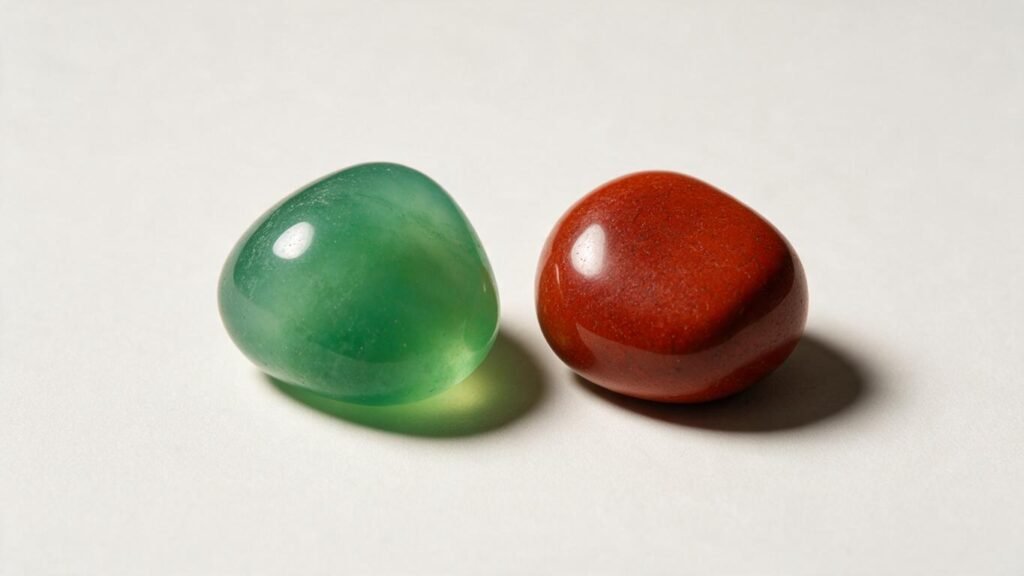
Jasper — Yashfeh, the twelfth and last of the twelve ancient stones
We end with the only name in the list we can follow all the way.
Eleven of these stones have left us guessing — a Greek approximation here, a lost referent there, a word that meant a category rather than a mineral. This one is different. יָשְׁפֵה — Yashfeh can be traced, step by step, across five thousand years and half a dozen languages, without a break.
And at the end of that unbroken chain, the word means something other than what it started as.
It is the right note to close on. Not because it resolves the collection, but because it shows exactly how the difficulty happens.
1. The Chain
Start in Akkadian, where yašpu names a stone. The Hebrew yashfeh is the same word. So is the Persian yašp.
The Greeks took it as iaspis. The Romans took it from the Greeks as iaspis. Arabic has yashb. Old French gives jaspre, and English, finally, jasper.
Six languages, one continuous thread, no mystery about the transmission. Among the twelve this is unique — everywhere else the collection has had to reconstruct a chain that broke.
So the word is secure.
The mineral is not, and the evidence for that is unusually specific.
Ancient iaspis was, in most descriptions, a translucent green stone — what we would now call green chalcedony, plasma or chrysoprase. Writers describe holding it to the light.
The clinching detail comes from Revelation, which describes iaspis as clear as crystal. Whatever the author of that text was picturing, it was not opaque.
Modern jasper is the opposite: opaque, dense, most often brick red or brown, impossible to see into.
The word travelled intact for five thousand years and arrived meaning a different material. In one line of interpretive tradition Yashfeh is associated with Benjamin; as ever, the text makes no such assignment and the commentators differ.
2. The Material, Both of Them
Both the ancient stone and the modern one are chalcedony — the same microcrystalline silica that has appeared throughout this collection as carnelian and as agate.
What separates them is purity.
Chalcedony that is relatively clean stays translucent, and takes its colour from trace elements: nickel or chromium for the greens that the ancients called iaspis.
Chalcedony that formed with a heavy load of foreign material — iron oxides, clay, the surrounding rock ground fine and incorporated as the silica set — becomes opaque. That is modern jasper. Up to twenty percent of it can be something other than silica.
Which produces the quality it is now prized for. Because jasper is essentially silica with the local geology mixed in, each deposit looks like nowhere else. Orbicular patterns, banding, dendritic growths, formations the trade calls picture jasper or landscape jasper because the cut face genuinely resembles a place.
The impurity is the design. A pure jasper would be a plain stone.
3. From Small Objects to Architecture
Jasper’s history is not really a history of jewellery. It is a history of surfaces.
It is hard, 6.5 to 7, takes a high polish, occurs in large masses, and is cheap relative to anything transparent. Those four facts together point in one direction: architecture and furniture rather than rings.
Byzantine and Roman interiors used coloured hardstone at scale — columns, revetment, floors, the deliberate juxtaposition of materials from across an empire as a demonstration of reach.
The Renaissance took it further. In Florence, the Medici established a workshop dedicated to hardstone work, and the technique it perfected — commesso, assembling precisely cut slices of coloured stone into images with no visible joints — produced tabletops, cabinets and eventually an entire chapel faced in the material.
The institution that grew from that workshop still exists in Florence as a conservation centre.
And the same idea travelled independently to Mughal India as parchin kari, the inlay we met in the first essay of this collection, where stone is set flush into white marble so that the pattern is not applied to the surface but constitutes it.
4. Where Traditions Meet
The word itself is the meeting point, and it is worth pausing on what that implies.
For yašpu to become yashb and jasper, merchants speaking different languages had to hand the same stone to one another, repeatedly, over thousands of years, each time keeping the seller’s word for it.
A word does not survive five millennia of transmission unless the thing it names keeps changing hands.
The name is therefore evidence — not of what the stone was, but of how continuously it was traded. Of all the material in this collection, this is the one that never stopped moving.
5. What the Surface Has Been Made to Say
Jasper does not have the symbolic tradition of emerald or amethyst, and the reason is structural: it is not one stone, it is hundreds of local stones sharing a name, and no consistent symbolism can attach to that.
What it has instead is an association with the earth — with rock as rock, ground and pattern rather than light and fire.
Where a transparent gem asks to be looked through, jasper asks to be looked at. It is the only material here whose interest is entirely on its surface, and whose surface is, quite literally, a cross-section of a place.
Cultures that valued it tended to value it for that: not as a jewel, but as a piece of somewhere, cut flat.
6. The Return of Stone Surfaces
Contemporary design has come back to hardstone with some force, and the reasons are worth naming because they are not nostalgic.
A stone surface is the opposite of a rendered one. It cannot be simulated, it is not repeatable, and it registers differently in person than in an image — which, in an era where most objects are first encountered on a screen, has become a genuine differentiator rather than a craftsman’s complaint.
Jasper in particular offers something the more prestigious hardstones do not: scale at reasonable cost. Lapis at table-top dimensions is a serious commission. Jasper is a material decision.
The contemporary uses follow — inlay, table surfaces, panels, objects, and the return of hardstone to watch dials, where jasper’s opacity does the opposite of what a transparent stone would.
7. What Makes It Distinctive
Yashfeh closes this collection by inverting its central problem.
For eleven stones, the difficulty has been that the words are lost, or ambiguous, or were catch-alls from the beginning. We have spent the series reconstructing broken chains.
Here the chain is intact and the meaning drifted anyway — quietly, without anyone noticing, one translation at a time, until a word that meant a translucent green stone meant an opaque red one.
That is the more unsettling failure mode, and the more common one. A broken chain announces itself. A continuous chain carrying a changed meaning does not.
It is the reason this collection has hedged as often as it has. Not because the sources are poor, but because confident transmission is not the same thing as accurate transmission, and only one of the two is visible from here.
8. A FEDIYAR Note
Twelve stones, four thousand years, and this is what the list actually contains.
A few identifications that hold. Several that are contested. One that is genuinely unknown. And one where the word arrived safely and the meaning did not.
That is not a failure of the record. It is what any real record looks like when it has been handled by enough people for long enough — and it is worth more than a clean list would be, because a clean list would have had to be invented.
The objects we care about have histories like this. Attributions that are strong in places and thin in others. Gaps where a century went unrecorded. Names that meant something different when they were given.
Knowing where the uncertainty sits is not a weakness in the story. It is the difference between a history and a sales pitch.
Beauty catches the eye. History holds the attention.
And knowing what you do not know is what keeps both of them honest.
FEDIYAR
The word arrived intact. The meaning did not.
That is usually how things are lost — not broken, but quietly changed in transit.
Previously: Shoham — the stone chosen to be written on.
This completes the collection. Return to The Twelve Ancient Stones.
A note on method: throughout this collection we distinguish three things — what the ancient text actually says, what later traditions made of it, and what modern mineralogy proposes. Where an identification is debated, we say so.


