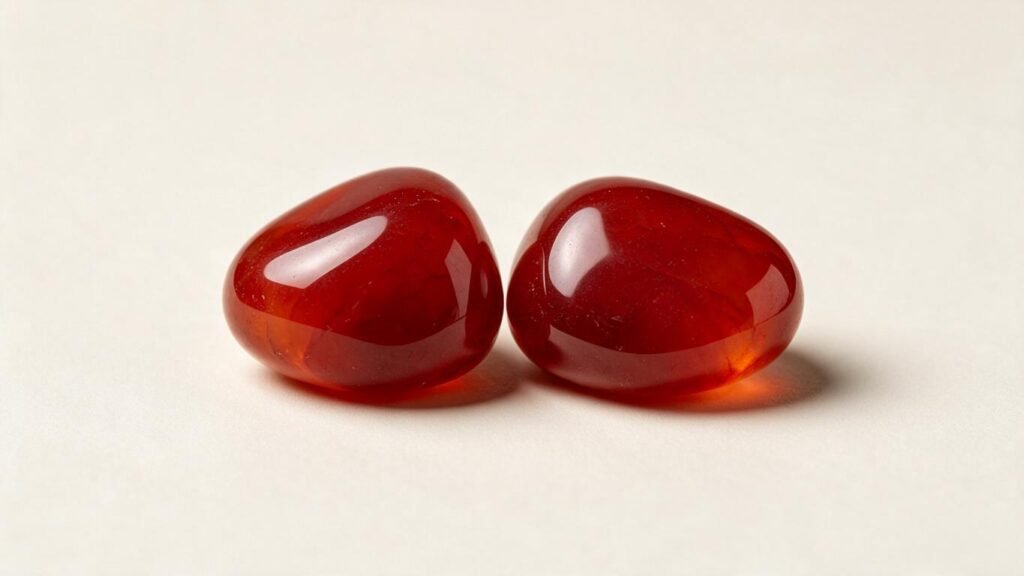
Carnelian — ’Odem, First of the Twelve Ancient Stones
You have to see wax being lifted away.
The wax is softened, the seal is pressed into it, then lifted: the impression remains crisp, while the stone retains its design.
The property seems almost trivial.
Yet it helps explain why a red stone could become, over several millennia, an essential material for people seeking to prove who they were.
A name engraved into stone could identify a person, authenticate a document, establish ownership, or signify authority.
Long before it became an object of jewellery, carnelian was therefore a material of trust.
In the Book of Exodus, the breastplate of the High Priest is described as set with twelve precious stones, bearing the names of the sons of Jacob.
The first is called ’Odem.
A word associated with red.
The breastplate is therefore not presented simply as a precious object. According to the Book of Exodus, it belongs to something commanded by God, intended to carry the names of the sons of Israel before Him.
But behind this first stone lies a much larger history: that of a material that travelled across civilizations, trade routes, religious traditions and centuries, while retaining one of its most distinctive qualities.
The ability to bear a mark.
1. A Name That Is Simply a Colour
The Book of Exodus describes the twelve stones placed on the breastplate of the High Priest. They are to bear the names of the sons of Israel, like seals, each representing one of the twelve tribes.
The first stone is called ’Odem — אֹדֶם — a term associated with red.
Ancient translations help illuminate its identification. The Septuagint uses sardion, while the Vulgate uses sardius. These terms have long been associated with the family of red stones now described as sard or carnelian.
The modern identification of ’Odem with carnelian — or more broadly with a red variety of chalcedony — is therefore strong, but it should not be turned into absolute certainty: modern mineral classifications do not perfectly correspond to the classifications used in antiquity.
This distinction matters.
An ancient stone is never only a stone.
It is also a word, and words change their boundaries over time.
From Red to Man
Yet behind this simple name for a colour lies a Hebrew resonance that is difficult to overlook.
’Odem, the name given to the first stone, belongs to the consonantal family א־ד־ם (ʾ-d-m).
It is the same sequence found in ’adam, man, and in ’adamah, the earth or ground.
This does not mean that the three words are interchangeable, nor that the Book of Exodus establishes a direct connection between the stone and Adam.
Rather, it reveals a linguistic and semantic proximity within the same consonantal family: red, earth and man echo one another within the biblical vocabulary.
The resonance is all the more striking because carnelian itself, through its colour, can evoke red earth, blood and living matter.
But the connection should be kept in proportion: it is a linguistic and symbolic resonance, not an explicit theological identification.
Within the biblical world, a name can be more than a simple designation.
Here, even before a tribal name is associated with the stone through later tradition, ’Odem already carries, within its own family of words, something of the vocabulary of earth and man.
And What of Reuben?
Another interpretive tradition then leads to Reuben, Jacob’s firstborn.
The Book of Exodus names ’Odem as the first stone and states that the twelve stones bear the names of the sons of Israel. It does not, however, explicitly say: “’Odem corresponds to Reuben.”
The association with Reuben rests in part on a tradition according to which the stones follow the order of birth.
Flavius Josephus, in his account of the breastplate, states that the names were arranged on the stones according to the order in which the sons were born. Within that framework, Reuben, the firstborn, would naturally occupy the first position.
This tradition should nevertheless be distinguished from the wording of Exodus itself.
The order of birth is explicitly discussed in ancient interpretations concerning the names engraved on the two shoulder stones of the ephod. The Book of Exodus, however, does not provide an individual assignment of each of the twelve breastplate stones to a particular son.
Thus, ’Odem = Reuben is an ancient association consistent with certain traditions, but it is not an attribution explicitly stated in the biblical text.
The distinction matters.
It allows us to follow the history of interpretation without making the text say what it does not say.
And it creates a remarkable progression:
’Odem. Red. Earth. Man. Firstborn. Name.
And finally, the name engraved in stone.
2. The Material
Carnelian belongs to the chalcedony family, a microcrystalline form of silica.
It generally has a compact, homogeneous and slightly waxy appearance. Its colour can range from luminous reddish orange to deep red, sometimes with brownish tones.
Its colour is primarily associated with the presence of iron compounds.
With a hardness of approximately 6.5 to 7 on the Mohs scale, the material is sufficiently durable for everyday use while remaining workable by specialists in hardstone carving and engraving.
It does not possess the pronounced cleavage found in certain crystalline minerals.
This is one of the qualities that makes it suitable for intaglio work.
An image can be carved into its surface without depending on natural planes of separation that could weaken the stone.
Carnelian therefore responds to the hand.
It can be polished.
It can be cut.
It can be drilled.
And above all, it can receive a mark.
3. A Stone That Was Already Travelling
Long before the great Mediterranean empires, carnelian was already travelling considerable distances.
In the Indus Valley civilization, as early as the 3rd millennium BCE, artisans produced highly sophisticated carnelian beads.
Some of these objects have been found far from their places of origin, including in Mesopotamian contexts.
The stone already had an international life.
It passed from hand to hand, from trading centre to trading centre, from civilization to civilization.
In ancient Egypt, carnelian was also used for jewellery, amulets and objects associated with power, protection and funerary practices.
Later, the Romans developed an especially important use for our story: the intaglio.
A hardstone could be engraved in negative relief so that, when pressed into wax, it produced a readable impression.
The same stone could therefore be an object, an instrument and a signature.
It is no coincidence that carnelian appears so frequently in the history of seals.
It possessed precisely the qualities that were sought: a sufficiently durable surface, a colour that made the engraving stand out, and a material capable of holding fine detail.
During the Middle Ages, some ancient stones were reused, preserved or reset into new objects.
The tradition of engraved stone never disappeared entirely.
It simply changed hands.
4. Where Traditions Meet
In the Islamic world, carnelian belongs in particular to the tradition of ’aqīq, an Arabic term associated with stones of this family.
Red stones have long been appreciated for rings and seals, within an enduring tradition of wearing engraved stones and signet rings.
In Yemen and several regions of the Arab world, traditions surrounding ’aqīq have retained a distinctive place.
What is striking when these traditions are compared is the continuity of one simple material quality.
The stone can receive an inscription.
It can carry a personal sign.
It can be set into a ring.
It can accompany the person who wears it.
From one civilization to another, the meanings change.
The material function remains.
The stone accepts the mark.
5. What Red Has Been Made to Say
Red is one of the most powerful colours in human history.
Yet there is no single universal symbolism of red.
Depending on the culture, it may evoke blood, life, power, courage, protection, desire, prestige or authority.
Carnelian therefore does not carry one fixed meaning.
It has been interpreted by different cultures, in different contexts.
What returns again and again is the visual force of its colour.
A red carnelian draws the eye.
It contrasts with gold.
It stands out against marble.
It gives depth to an engraving.
It transforms a mineral surface into a presence.
Perhaps this is why the stone has travelled through so many traditions without losing its decorative power.
It does not need to be transparent to be precious.
It needs to be right.
Right in its colour.
Right in its cut.
Right in its relationship with other materials.
6. Jewellery and Watchmaking
Carnelian never needed to be the rarest stone to find its place in the world of luxury.
It belongs to another category of stones: those whose appeal lies in colour, material and the hand of the lapidary.
In jewellery, it can be fashioned as a cabochon, bead, plaque or engraved stone.
Its colour — from luminous reddish orange to deeper reds — works particularly well with precious metals.
Set in yellow gold, it gains warmth.
Paired with white gold or more restrained lines, it becomes more graphic.
In every case, it brings a chromatic presence that transparent gemstones express in a different way.
But it may be in engraving that carnelian reveals its heritage most clearly.
Since antiquity, its homogeneous structure has made it a favoured material for intaglios.
A surface of carnelian can receive a figure, initials, an emblem or a name, transforming a coloured stone into a personal object.
This is an essential difference from a stone chosen purely for its brilliance:
carnelian can carry an identity.
The Stone Enters the Watch
Watchmaking has offered it another surface: the dial.
Cut into thin slices, carnelian can become a stone dial whose colour and nuances depend directly on the piece selected.
The natural variations of the material — intensity of colour, translucency, and areas of differing saturation — mean that no two dials are ever perfectly identical.
This irregularity is not a flaw to be corrected.
It is precisely what fine watchmaking can seek when natural stone is used: a watch whose material cannot be reproduced exactly.
The process is therefore as much about selection as manufacture.
The lapidary must choose a section of the stone capable of producing the desired visual character, then cut it with enough precision to obtain an extremely thin plate.
The dial maker then drills, fits and finishes the material around the hour markers and other indications.
The result possesses a particular quality.
The watch does not simply carry a red colour.
It carries a fragment of stone that will never exist in exactly the same form in another watch.
This logic surprisingly echoes that of the ancient seal.
Then, carnelian was chosen because it could preserve a personal mark.
Today, it can be chosen because it allows a watch to carry a singular piece of nature.
In both cases, its value does not come only from what it is.
It comes from what we entrust to it.
From Precious Stone to Material of Creation
At the beginning of the 20th century, as European houses rediscovered the decorative possibilities of hardstones, carnelian joined onyx, jade, lapis lazuli and other coloured materials in an aesthetic in which surface mattered as much as transparency.
The renewed fascination with ancient Egypt that followed major archaeological discoveries in the early 1920s further encouraged an appreciation for stones with strong colours and geometric forms.
Carnelian thus found its place in a new conception of luxury: less focused on the intrinsic value of the stone alone, and more attentive to composition, contrast, colour and craftsmanship.
Yet its story extends far beyond Europe.
In parchin kari, the Mughal art of inlaying stones into white marble, carnelian can be cut into petals and leaves and fitted flush into the surface.
The motif is not simply placed upon the marble.
It becomes part of it.
Florentine commesso pursued a comparable approach in Europe through hardstone work: selecting, cutting and assembling mineral fragments to create images in which the material itself becomes part of the language.
In these traditions, as in contemporary jewellery and watchmaking, the stone is selected not only for its value, but for what it allows the maker to create.
The signet ring remains perhaps one of the places where its heritage is most clearly visible: a stone chosen not merely to be admired, but to receive a mark.
We will explore this tradition more closely in the study devoted to Shoham, another stone associated with the ancient twelve stones.
7. What Makes It Distinctive
Carnelian is not, in itself, an exceptionally rare stone.
And that is precisely what makes its history interesting.
Its value does not necessarily come from how difficult it is to find.
It can come from the quality of the material, its colour, its cut, its engraving, the object into which it is incorporated — and above all, from what it has carried.
Many carnelian objects bear an individual trace.
A name.
Initials.
A face.
A symbol.
A coat of arms.
A scene.
An intention.
The stone then becomes more than a material.
It becomes the physical support of a human decision.
Gold can be melted.
A setting can be dismantled.
An object can pass from one owner to another.
But an ancient engraving can remain.
Perhaps this is one of carnelian’s deepest qualities.
It does not seek to be eternal.
It is simply durable enough for something of human intention to survive within it.
8. A FEDIYAR Note
Rarity is the easiest form of value to explain, and perhaps the least interesting.
The more difficult form belongs to objects made to carry something.
Carnelian never needed to be the rarest stone to become precious.
What makes it remarkable is what human beings have entrusted to it: a name, an impression, a face, a symbol, sometimes a story intended to cross generations.
On an ancient seal, a man engraved a name. That name was legible to those who needed to recognize it, and a trace of that intention can still reach us centuries or millennia later.
The stone did not create that meaning.
It consented to hold it.
That is the quality that interests us at FEDIYAR: the ability of an object to carry something greater than itself.
Not the highest price,
but the greatest capacity to carry —
a story,
a name,
the passage from one hand to another.
FEDIYAR
The most precious objects are not always the rarest.
Sometimes, they are simply the ones that know best how to carry what matters.
This is the first essay in The Twelve Ancient Stones.
Next: Peridot — the stone named after a search.


