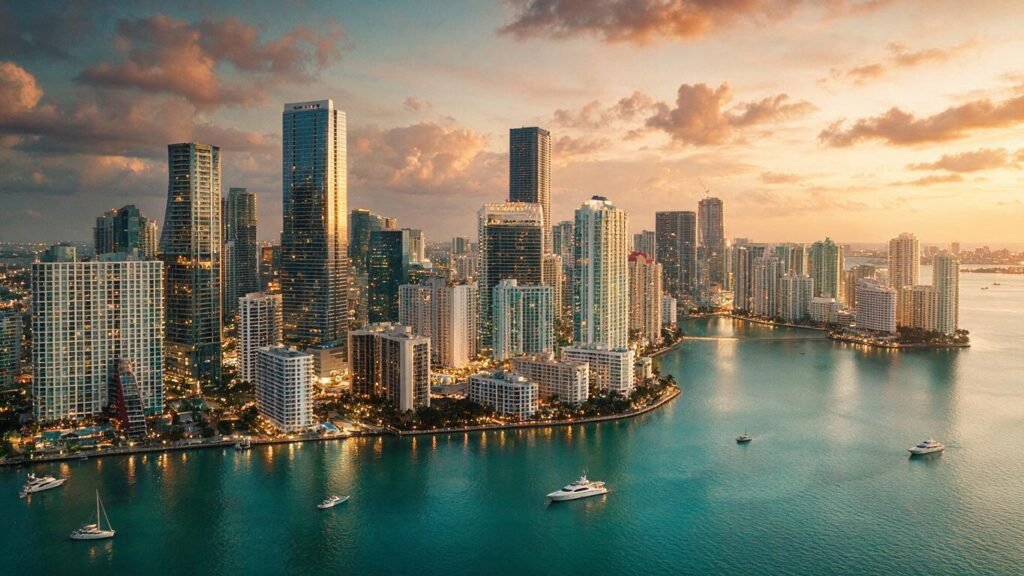
Miami is no longer just a resort destination — it has become one of the world’s premier markets for prestige real estate. A futuristic skyline over Biscayne Bay, branded residences, private marinas and a famously light tax regime draw an international clientele in search of an exceptional pied-à-terre or a smart store of wealth. Here is everything you need to know before buying in 2026.
Why Miami attracts international luxury buyers
Three forces converge. First, a mature, active high-end market where a large share of transactions close in cash — the mark of a solid, international buyer base. Second, an evolving supply: branded residences and office-to-residential conversions are refreshing the premium inventory. Third, a tax environment few global metropolises can match.
A decisive point for foreign buyers: Florida grants non-residents the same ownership rights as U.S. citizens. No visa is required to buy (though buying does not grant residency).
Prestige neighborhoods and 2026 prices
In Q1 2026, the luxury market (properties at $1M and above) shows a median price of about $1.84M, around $1,040 per square foot, with an average of about 93 days on market. Here are the benchmarks by area:
- Brickell — Miami’s financial and urban core: about $950 per square foot (a record high).
- Miami Beach — The iconic oceanfront address: about $1,178 per square foot.
- Coconut Grove & Coral Gables — Green, residential, boutique luxury: about $949 per square foot.
- Fisher Island — The most exclusive enclave: about $2,391 per square foot.
- Ultra-luxury segment ($2M and above): median price of about $3.64M.
The buying process, step by step
- Offer and escrow deposit: 1–3% of price, held in escrow.
- Inspection period: 10–15 days to have the property assessed.
- Financing (if applicable): allow 45–60 days for underwriting.
- Closing: 15–21 days for a cash purchase, 30–60 days with a loan.
In Miami, properties sell in roughly 90–105 days on average.
Financing as a foreign buyer
- Down payment: typically 20–30% for a foreign buyer (vs. 10–20% for residents).
- Rates: around 6.75–7.5% in 2026, depending on profile and lender.
- Term: 15–30 years.
- Documents: passport, ITIN (U.S. tax ID), bank statements, proof of funds.
Taxes: what Miami changes for an international buyer
- No state income tax in Florida. Only federal taxation applies.
- Annual property tax: roughly 1.8–2.1% of assessed value.
- Capital gains: after one year of ownership and deductions, a base widely seen as more stable than in high-tax countries.
- Rental income: taxable, but many costs are deductible and the asset can be depreciated.
- FIRPTA: when a non-resident sells, the buyer withholds 15% of the price under this federal law.
- Tax treaties: designed to avoid double taxation; specialist cross-border advice remains essential.
Costs beyond the price
- Closing costs: title insurance (0.5–1%), documentary stamps (~0.7%), fees, inspection.
- Annual costs: HOA of $300–$1,500+/month, home insurance of $2,000–$8,000/year.
Owning through an LLC: useful, with conditions
Many international buyers hold their property in an LLC: liability protection, privacy and estate-planning flexibility. To be weighed with a cross-border tax advisor.
The FEDIYAR selection
At FEDIYAR, we list only exceptional addresses and properties.
“Luxury real estate professionals: join FEDIYAR — be among the first to have your listings published.”
Illustrations generated by artificial intelligence.


